However, this is only partly true. To start with, all languages that have been documented have a repertoire of words, so-called onomatopoeia, words that refer to sounds in the world. This can be sounds that animals make, so, for example, cuckooduloodo, or objects make, so, for example, ding dong, ring, trilling and so forth. And these words are common across languages, as I said. In some languages there is a small repertoire of these words. In other languages, the repertoire is larger. Japanese is an example of a language that has a large repertoire. In addition to these onomatopoeic words, all languages have some sounds they use that have kind of an imagistic quality. So some work shows that across languages, the R that we use in rough, in fact, has this quality and it's used to refer to objects and things that in fact have this roughness about them.
Language beyond words
Professor of the Psychology of Language
From iconic sounds and gestures to sign languages and cultural differences, human language emerges as deeply embodied, visual, and rooted in human experience.
- Words are not completely arbitrary: across languages, sounds and onomatopoeia often carry meaning and can resemble properties of the world they describe.
- Sign languages and gestures show that human communication is deeply visual and multimodal, using hands, facial expressions, gaze, and body movement alongside words.
- Iconic language and gestures help both children and adults learn, understand, and remember meaning by creating more direct links between forms, actions, and experiences.
- Languages share many common features because humans have similar bodies and experiences, but they also differ greatly across cultures, shaping how people express ideas such as color, hierarchy, respect, or even the self.
Words, sounds and meaning
Usually language is defined as a system of arbitrary symbols and rules for manipulating these symbols. And well, that seems quite obvious, doesn't it? So that furry thing that moves around the house, that barks and that we like to pet, it's called dog in English, it's called perro in Spanish, it's called cane in Italian. And the sounds in none of these words have any resemblance to what the dog looks like or the noises that the dog makes. So in a sense, words are just arbitrary pointers to referents in the world. This is the received view.

© Shutterstock
Iconocity in language
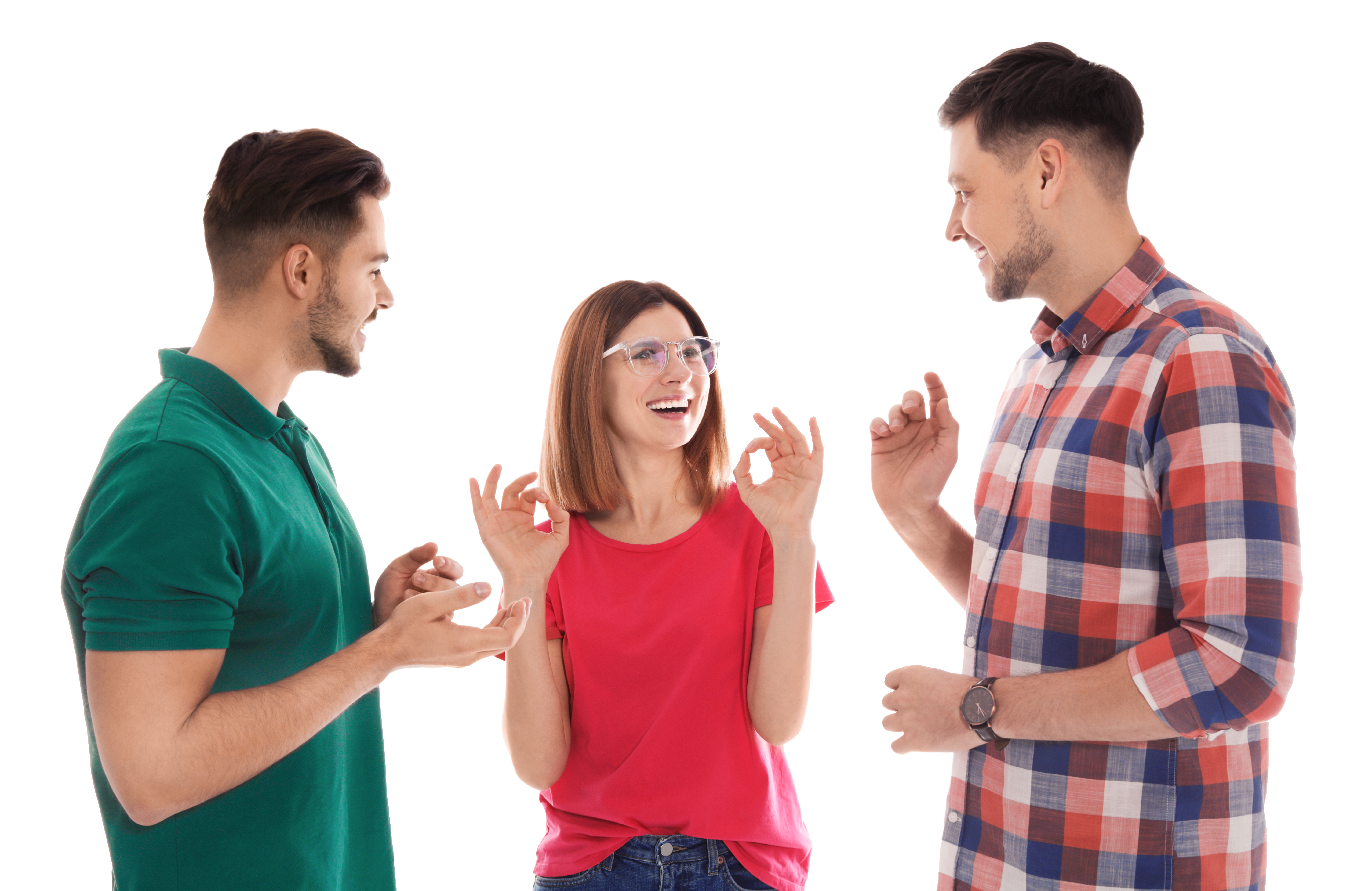
Iconicity can be defined as a transparent relationship between properties of a signal —for example, a word - and its meaning. As I said, it's present across languages. It's not just limited to a small set of words, but it is present in terms of sounds evoking properties that are meaningful. It's also very visible in sign languages. Sign languages are the visual languages used by deaf communities around the world, and sign languages tend to also have a number, in fact, quite a large number of iconic forms.
© Shutterstock
In general, in fact, sign languages tend to have more iconicity than spoken language in the language itself, which may be explained very simply in terms of the primary modality of the language. And there are only so many things we can do with our voice to evoke properties of the world. But there is a lot more we can do with our hands to evoke visual properties of the world.
The power of images in language
Why would languages be iconic at all? Well, iconicity confers an advantage when it comes to learning and also when it comes to processing by virtue of having this more transparent, imagistic relationship between the form of the word and the meaning. So, for example, we know that very often among the first words that children learn are onomatopoeic words like animal sounds, or the word yuck. Also, we know that these iconic features render understanding and also producing and retrieving words easier in adulthood.

© Shutterstock
Why would we have both iconicity and arbitrariness? Well, in a sense, iconicity is related to features that are related to our sensory experience, to our motor experience. And there's less iconicity when it comes to abstract words. And instead, arbitrariness, combining phonemes in an arbitrary way, provides us with kind of an infinite number of ways to create new meanings in a language. This might account in part for why both iconicity, that gives you an advantage when it comes to learning and processing, but also arbitrariness are important aspects in languages.
Talking with our hands
Until now, we've been talking about language in terms of primarily speech as something unimodal. But actually, if we think about the context in which children learn language and in which we very often use language, this context is face-to-face. And in a face-to-face context, the child learning or someone listening has access not just to the words that are being produced by a speaker, but to a lot more. They have access to the facial expressions that the speaker is making, which can express emotion, can express a question, for example. They have access to where the speaker is looking, and speakers tend to direct their attention, their looks, to the things they are talking about. They have access to seeing the body of the speaker, and the body itself. The trunk can convey a sense of excitement for what is being said.

© Shutterstock
And of course, speakers, while they are talking, use their hands. This is common across cultures. It's not the case that some cultures necessarily gesture more than others, although certainly gestures are more culturally accepted in some cultures than in others, like in Italian culture, and in this case, they may be displayed more often, but they are common across all cultures that have been investigated. Especially when people are talking about space, or they're talking about giving directions.
Language from the body
All these different elements, signals that come from the face and in particular from the hand, are incredibly tightly, and when I say tightly, I mean at the millisecond level, integrated with the speech. They seem to be indeed an integral part of language. And they do contribute to communication; they're not just redundant with the speech: they help clarifying, they help directing attention. If we consider specifically gestures, gestures come in different types. A first type is pointing. Pointing is a very specific type of gesture that we see primarily in humans. There's some debate if primates use pointing gestures or not. These gestures are special because they draw attention not to the hand itself, but to the “thing” being pointed to.

© Shutterstock
Another very interesting type of gesture that people use in face-to-face interaction is iconic gestures. These are gestures that bring about some meaning information related to what the speaker is talking about. So, for example, if I'm talking about having played yesterday with a ball on the beach, I can make a gesture with my hand that kind of represents the silhouette of a ball and give you information that is not in my speech about the dimensions of the ball that I've been using.
Why we gesture
One key feature about iconic gestures is that these tend to be produced especially when people are talking about something that is not there and talking about something displaced. It's as if these gestures are attempting to bring into the space of the communication concrete properties of the situation, of the things that are being talked about. And this is key and something that indeed can play an important role both during learning and during processing in adulthood.

© Shutterstock
We also see that people who are blind from birth, who could not have seen others gesturing and gestured themselves, actually do it both when they are talking to another blind person, as well as when they are talking to someone who can see. Which is also interesting because these gestures are not being produced because someone told them, look, if you gesture, you help someone who sees. They seem to be intrinsic. I also wanted to mention that gestures are not just produced by hearing individuals hearing spoken languages. Gestures are also being used by signers, and they are kind of intercalated, intertwined with the manual signs. And also in signing individuals, they seem to be serving some of the same functions as they serve in spoken languages.
The diversity of language
There are many similarities among the languages in the world. For example, with respect to what aspects of realities are encoded in the language itself. And these similarities are related to the fact that, well, human beings have more or less similar bodies across cultures and places, and they have some basic experiences that are quite similar, including a drive for communicating. But there are also very many interesting differences if we look across languages with respect to what is being encoded into language.
© Shutterstock
So, for example, there have been documented very important differences with respect to how many color terms people use in a language, with some cultures using only a few color terms indicating broad categories and some languages instead using quite a large number of them. And differences may be more important when we look at more abstract concepts that are more culturally mediated and, in a sense, negotiated within different communities. But I just want to mention here that we don't quite know how many differences there are out there, and how deep differences can run because our work in cognitive science and in neuroscience has been limited for decades to just a handful of cultures and a handful of languages. So, for example, ten years ago, a paper reported that 80% of the psychological research conducted globally was conducted actually just in the US and in the UK.
Language and culture
Language is clearly intertwined with culture. So, for example, those cultures that put a lot of weight on hierarchy and respect, like the Japanese culture, have a number of markers in the language to refer to different positions, hierarchical positions, and different levels of respect that you have toward a person.

© Shutterstock
We also know that Western cultures tend to be more individualistic while Eastern cultures tend to be more related to the collectivity, and this changes the meaning of words like the self, which is quite different in these different types of cultures. Cultural differences are closely intertwined also with differences in the environment that people live in.
Editor’s note: This article has been faithfully transcribed from the original interview filmed with the author, and carefully edited and proofread. Edit date: 2026
Discover more about
Language beyond words
Perniss, P & Vigliocco, G, (2014). The bridge of iconicity: From a world of experience to experience of language. Philosophical Transactions of the Royal Society B, 369, 20140179.
Murgiano, M, Motamedi, Y & Vigliocco, G, (2021). Situating language in the real-world: the role of multimodal iconicity and indexicality. Journal of Cognition, 4(1).