


If I look now where we are in the field of exoplanet research, I think the picture has dramatically changed. We know that there are planets everywhere in the universe. In 30 years, we moved to none into as much as you have stars essentially. The idea that when you have a star, you make planet now it's obvious. That's the first learnings.The second one is that we have found planets in all the configurations you can imagine. We can even say that we have done better than any sci-fi movie in the many configurations we can think of, and in all the kinds of planets that exist.
Planet means life
For every star there is at least one planet, if not more. Now the question is what is the planet like? And that is still to be found.
Professor of Physics
07 Apr 2026
Citation-ready summary
For every star there is at least one planet, if not more. Now the question is what is the planet like? And that is still to be found.
Author: Didier Queloz
Last updated: 07 Apr 2026
Canonical URL: https://www.joinexpeditions.com/exps/1363-planet-means-life
Key Points
- Exoplanet research has revealed planets everywhere and in far greater diversity than expected.
- The question of planets quickly becomes a question about the possibility of life.
- Future progress depends on new instruments, direct observation, and exploration of our own Solar System.
- Queloz’s work has become increasingly interdisciplinary, connecting astronomy, chemistry, biology, and broader systems thinking.
Planets everywhere
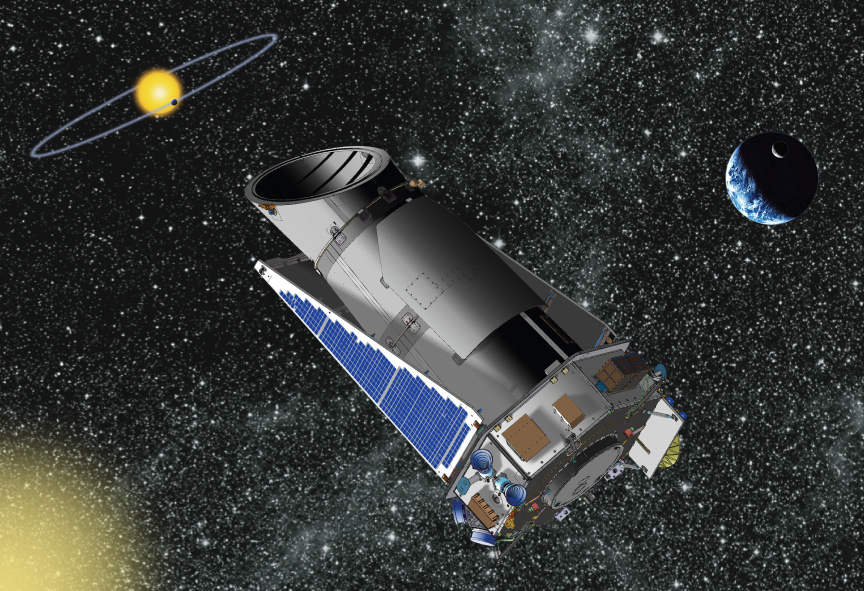
The NASA Kepler mission, launched in March 2009, searches for extrasolar planets, © Wikipedia
We are not in a position to detect an Earth twin yet. As of today, we can detect Earth-sized or Earth-mass planets, but they are usually closer and have slightly different orbital characteristics. There is still a whole field of exploration that we have not really covered. But there is something clear: for every star, there is at least one planet, if not more. It would be awkward for a star not to have a planet. Now the question is what is the planet like? And that is still to be found.
The possibility of life
The other element, which also interesting is when we look at the solar system and we look at these many other systems, we feel a little bit in an awkward situation because the solar system looks different from what we have found.
We are already aware that the Solar System, even if it exists in significant numbers across the galaxy, is not the archetypal model. It's really a kind of a concept that now is broken. The Solar System is not the model; it is simply one among many. I used to compare this with the flowers. A solar system is a rose. You have rose in many gardens maybe, but if you look at all the possibility of growing flowers on planet earth, you realize that the rose is just one among many.
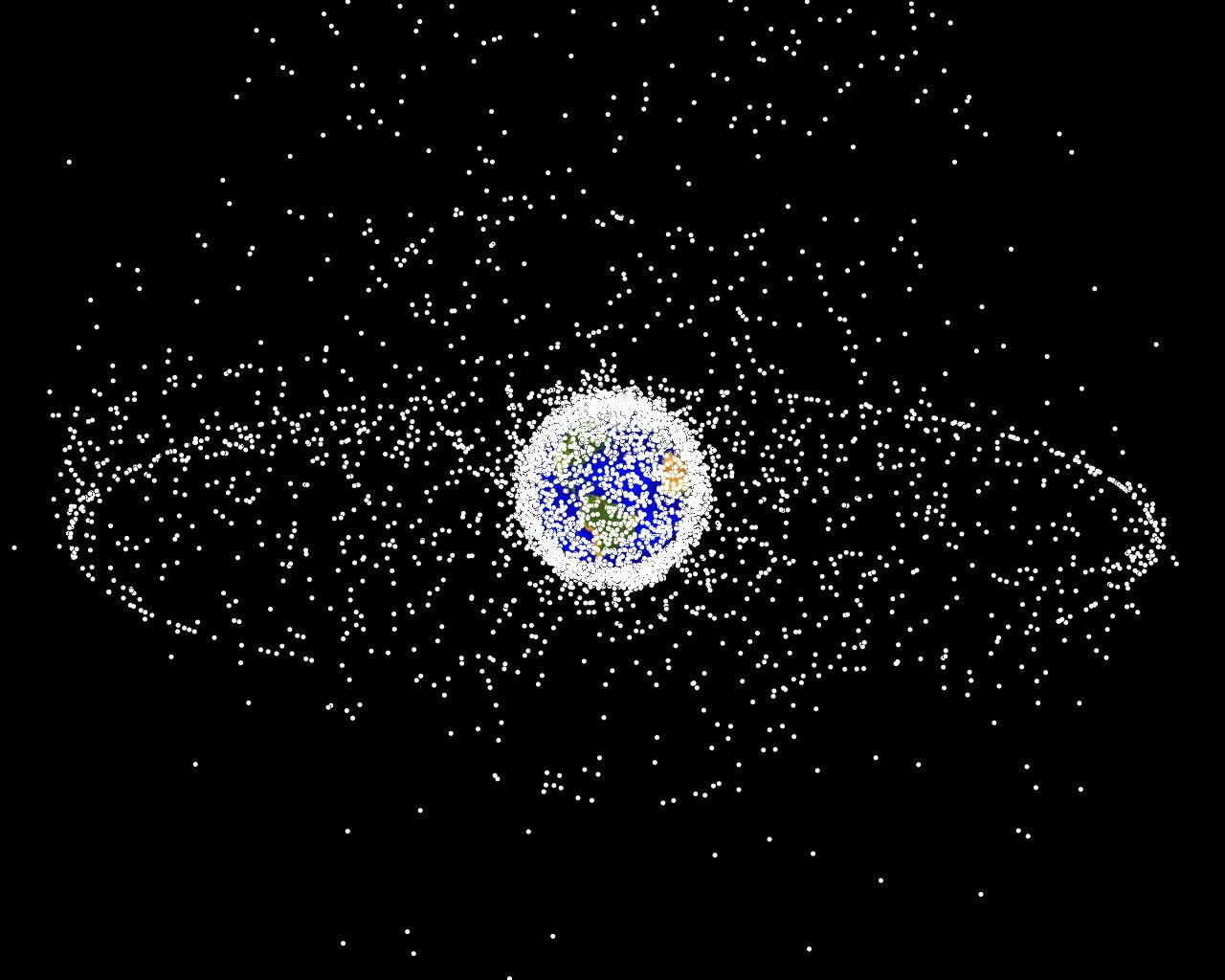
A computer-generated image mapping the prevalence of artificial satellites and space debris around Earth in geosynchronous and low Earth orbit © Wikimedia
And of course, the fact that we have so many planetary systems and a large fraction of them being rocky, opens this window about the possibility of life, the possibility of life with two angles. Is life the way we know it because of the specific conditions of Earth as a planet? Or is life, in its form, a kind of universal concept — something that is always the same?
We could expect to find life in a similar way, in a similar form on another planet but the fact we have such a diversity into the planet kind and type is maybe another warning here, that maybe life may be more diverse than we think, which means it may be more difficult to detect because if you don't know what to find, how would you find it?
New instruments
The detection of planets require machineries. We are still very “old fashioned” because we use ancient techniques, which is measuring essentially the transit, detecting change of light or detecting motions either by radial velocity or by astrometry. There are a couple of equipment that we're using right now. The best way is to go to space. And there's a couple of space missions. They're not super complicated. They are just a big camera looking at many stars.
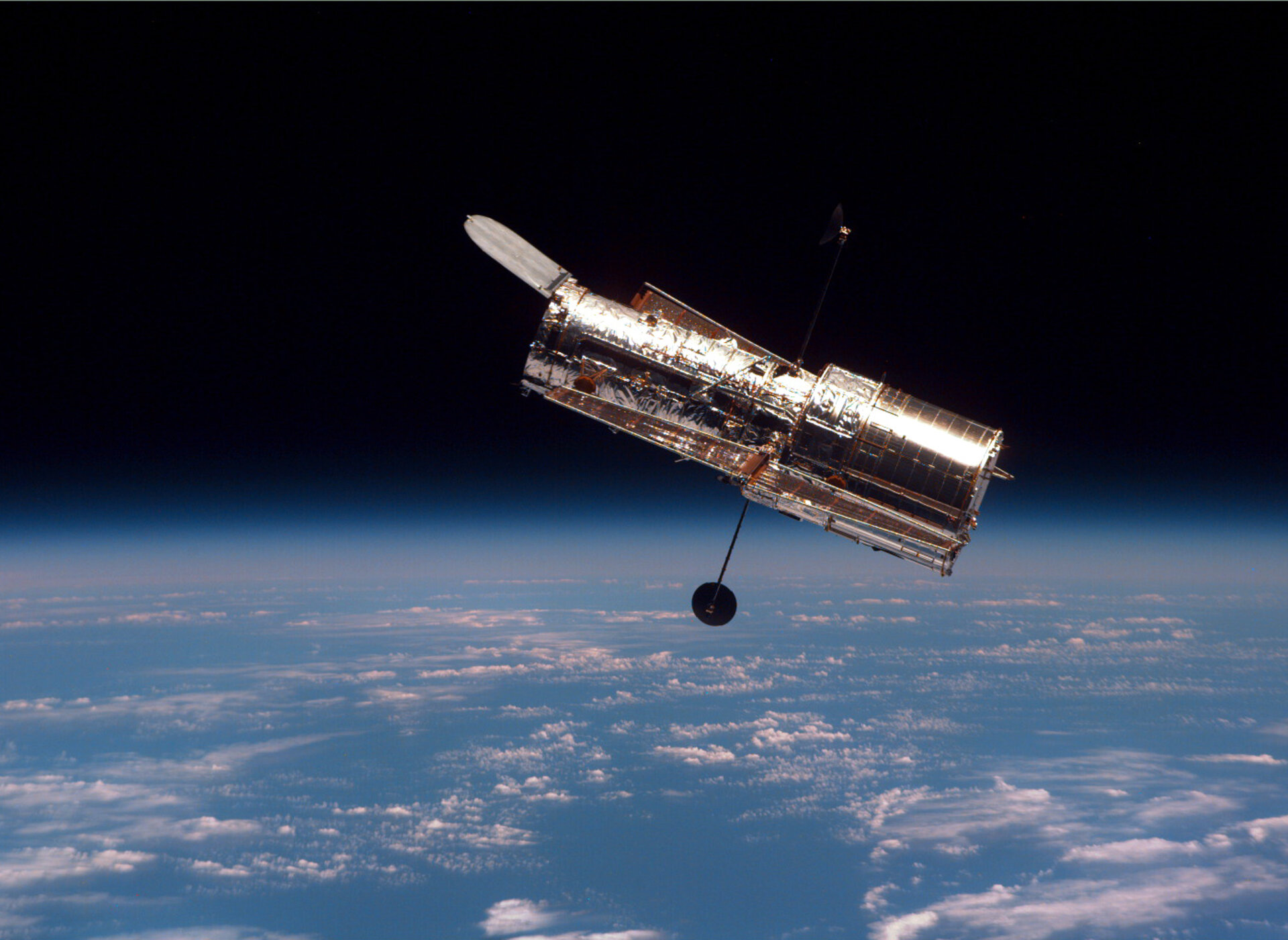
Hubble in free orbit, © ESA
The real next stage here is when we will be able to make a picture and I'm not particularly interested about the picture. I'm interested about extracting the light from the planet directly. It requires a new kind of machinery. We have partially done that, but that's very, very limited right now. The big improvement will come with big space hardware that will come in the future. And we'll be able to build massive telescopes, maybe 40, 50m, 100m in space.
If you look back 100 years ago, the biggest telescope you would have on 100 years ago was the Mount Wilson, a two meter class telescope. The biggest telescope you have is ten meters. And we're even flying a telescope, which is the size of six meters in space. It would be pretty obvious to have in space telescope of the size of the one on the ground. We are building now a 40 meter telescope on the ground. I think it will be in space or it will be on the moon, but it will happen. 100 years is a tremendous time scale. When you think about the growth of technology, how much the world is changing in just ten years, it's very easy to extrapolate about our future capabilities to see better, and that's really where the big progress will come. On the other hand, we will also explore in a more systematic way the solar system. It takes a couple of years to travel between the the places in the solar system. We can land and bring back sample. We have to return piece of Mars to study in detail whether there has been life on Mars. It's one of the predictions because Mars for the first billion years was kind of the same than the earth with water. There is an expectation that life that happened on earth in the first billion years may have happened as well on Mars. We want to detect traces of this ancient life.
I do believe that these two developments are going to change our perceptions about how life fits in the universe from a local perspective in the solar system, and also looking for the possibility for other planets to be similar to the planet Earth or Mars, or maybe Venus as well, but looking at other stars.
Surprises
When I presented my PhD and talked about 51 Pegasi, I said at that time that if we can detect a planet like that that exists, it would mean the planet can be much more diverse than we think and we should be ready for finding more planets that are kind of unexpected. I was proven right in this because we kept finding planets. They were unexpected. Most of the planet actually are not the same that the solar systems. And that is a big surprise, because there was still a general assumption that the Solar System was the model, and that other planets were the result of an extreme series of events that produced them. And actually this is not true.
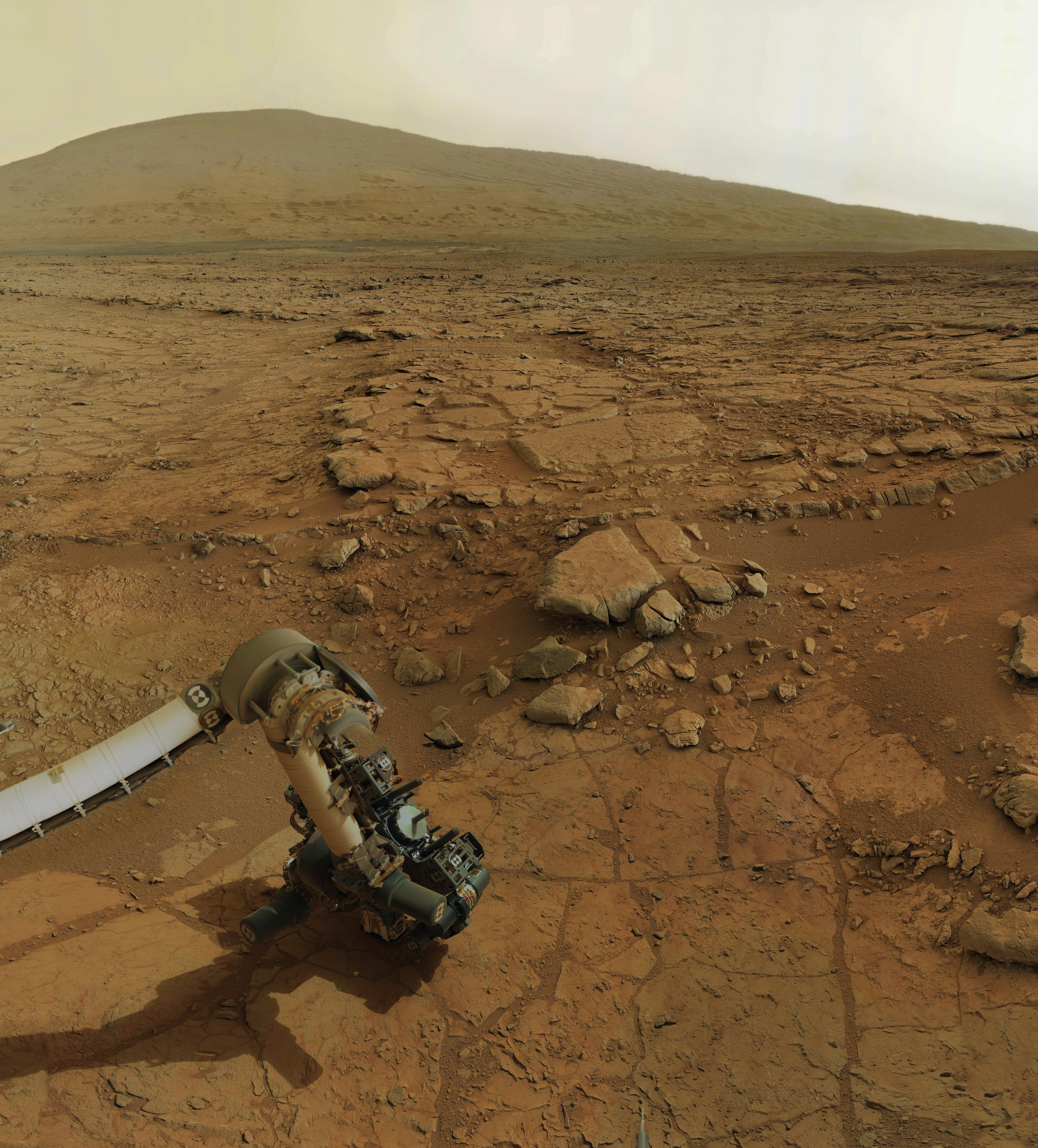
View of Mars © NASA via Wikipedia
But what was a real surprise and is still a surprise to me is to see the reaction of the media and the public, because there is one element when the media public overreacted at that moment and keeps overreacting, is not the fact there is a planet but that planet means life. And then people push it even further. They're talking about alien civilizations and Drake equation, all that stuff, which to me is a complete different topic of discussions.
What is interesting is addressing the questions, why do we have life on planet earth, and what does it mean for the other planets? And to me, it has been a complete change because I realized that being exposed to colleagues, not being astrophysicists, but being chemists, biochemists, biologists or scientists, they had a completely different take on all this. At my first meeting with them, I did not understand anything they were talking about. I was shocked, because I realised that if I really wanted to talk about life, I had to understand what they were saying — they are part of the equation. It took me a couple of years to digest this diversity. And I became convinced that if we want to make progress, we have to change the system. We cannot keep people working within the narrow boundaries of individual disciplines. Addressing the question of life in the universe — the question behind planets, as sensed by the media and the public — is something science can tackle, but only if we change the way we do it. We must embrace the complexity and diversity of this multidisciplinary field, and that is where I began to devote my efforts.
A new way of thinking
I’m trying to restructure institutions in a way that embraces this big topic, by helping people who want to work in the somewhat awkward spaces between the usual boundaries of disciplines. I can tell you it’s a fight, because the system is not designed for that. Typically, astrophysical proposals are made for astrophysicists and evaluated by astrophysicists. When you try to move beyond these usual boundaries, it requires a lot of energy. Thankfully, I do have that energy. And now, with the Nobel Prize, it helps to convince people that perhaps it is time to think about the world in a more complex way.

Didier Queloz receiving the Nobel Prize in Physics, 2019 © Alamy
It is interesting to compare this with other major challenges we face in society, such as the impact of global warming. Global warming is a similar kind of problem: it cannot be addressed in a single way. You cannot rely only on physicists or atmospheric specialists. You also have to engage economists, psychologists, and experts in social psychology.
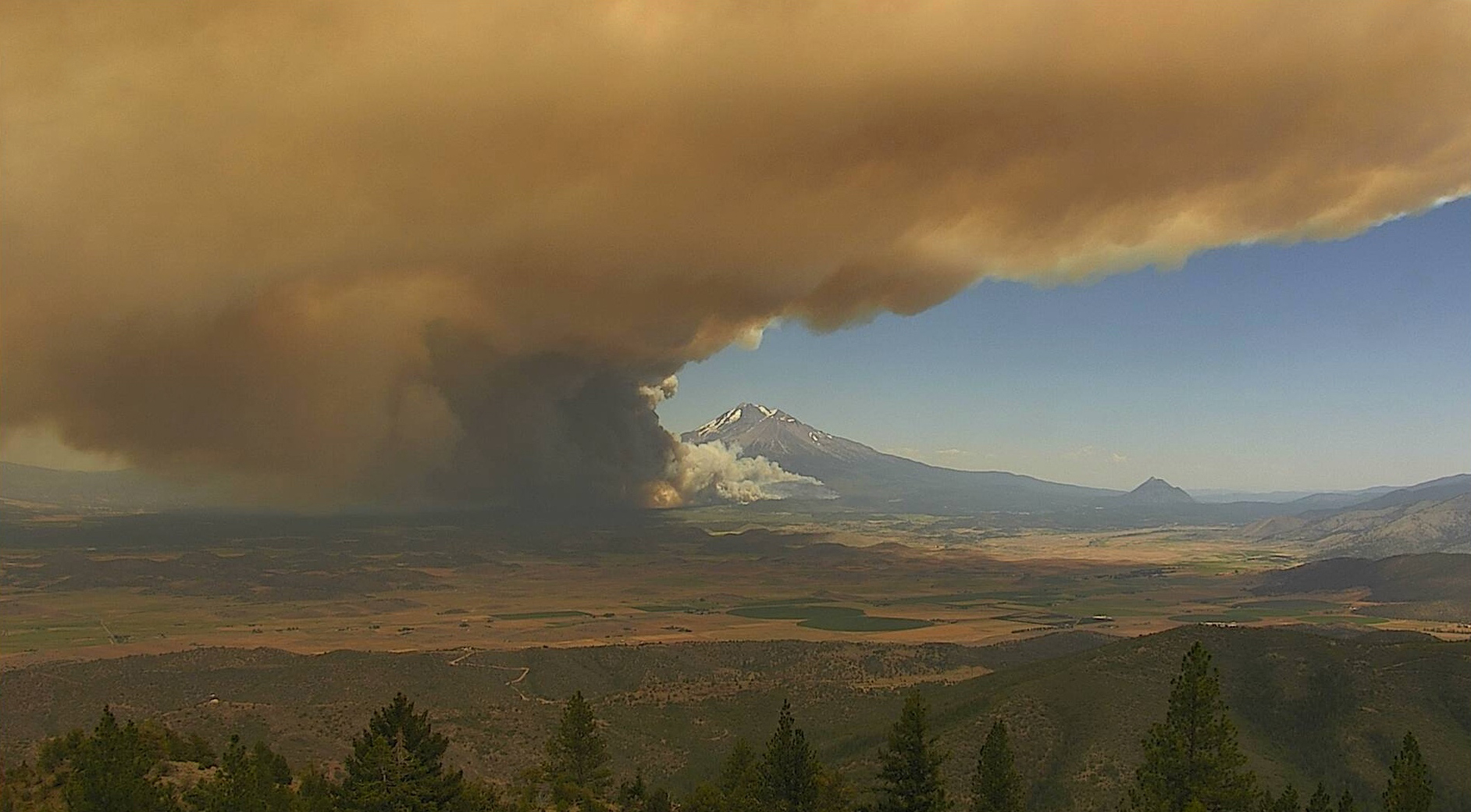
Wildfire caused by heat and dryness, © Wikipedia
How do you bring this way of thinking into society and reflect it in how we organise ourselves? It is a very complex problem. Approaching an issue from only one angle can lead to the wrong solution, or to missing the point entirely. My own focus is not on global warming but on the question of life, yet I am trying to approach it in a more holistic way. For me, this has been a real transformation in how I think.
Stability and chaos
We have three planets that could potentially host life: Venus, Earth, and Mars. It is possible that all three experienced the onset of life early in the history of the Solar System. Today, only one is likely to host life. I do not think there is life on Mars — though I may be wrong, and I hope I am. But I do believe there must have been life on Mars, and possibly on Venus, early on, because the conditions may have been similar to those on Earth.
This raises the question of timescales. It is not only about something happening, but also about how much time is available for physics to operate and for chemistry to develop and explore possibilities. If you look at the evolution of life in the Solar System, it takes a long time: from the emergence of life within the first billion years to the Great Oxygenation Event, which occurred two to three billion years later.
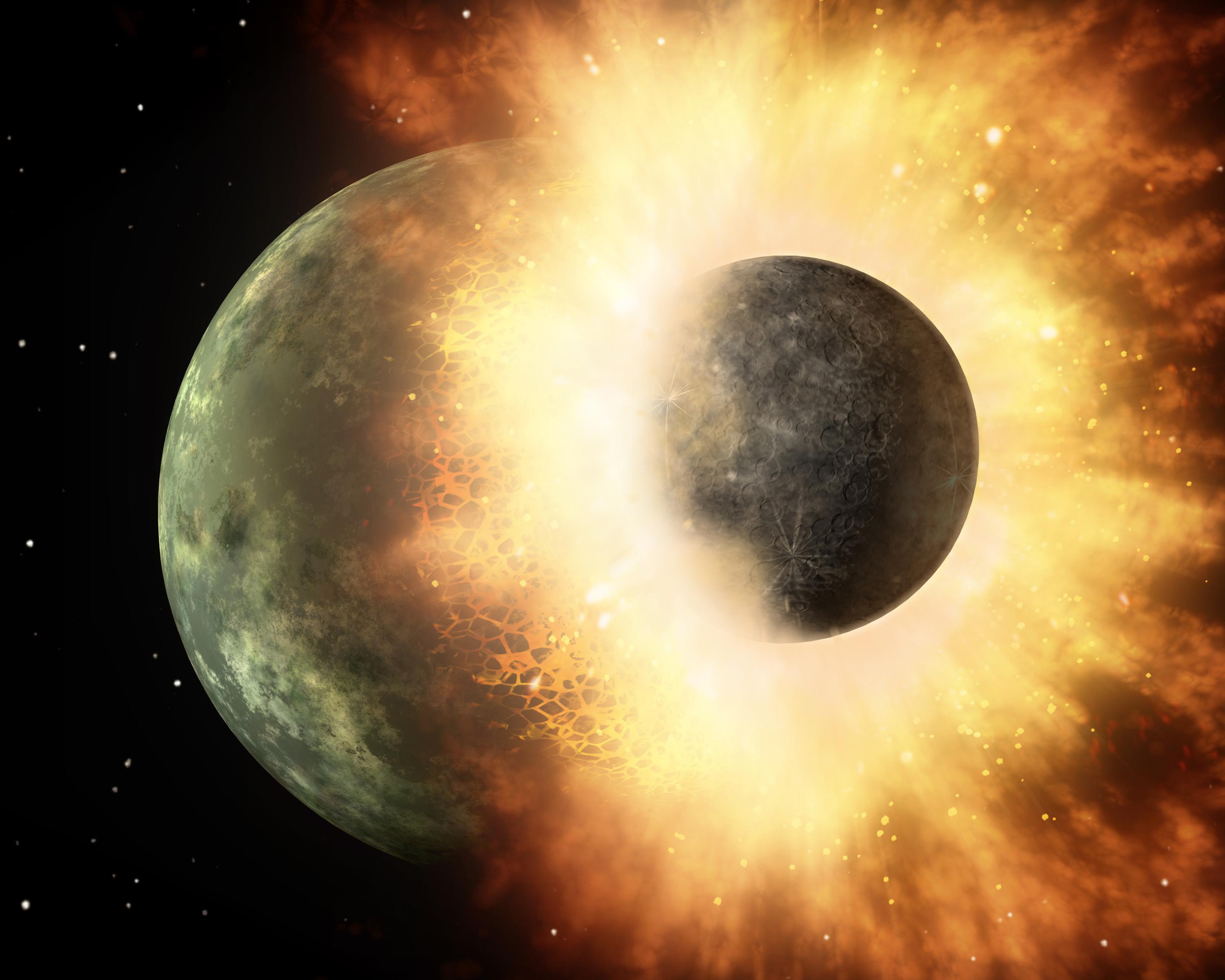
Artist's depiction of the collision between Proto-Earth and Theia, © Wikipedia
And then only in the last half-billion years do we see animals and the great Cambrian explosion. Consciousness comes only in the last million years. Stability and chaos play a key role here, because if a planetary system does not have the required stability to enable the continuation of biology, then it is over.
Perhaps the Solar System is unique in that respect, because it is an amazingly stable system. People have long asked how stable the Solar System is. As things stand, it is stable at least until the Sun begins to grow and move to another stage. The stability of the Solar System is, for now, a given. The only instability comes from occasional events, such as asteroid impacts. And every 10 to 15 million years or so, there must be a major impact event, which is not necessarily a bad thing because it resets life to some extent. For us, it was beneficial, because without that reset at the end of the dinosaurs, we would probably not be here talking today. Stability and chaos are really important elements here. Now, of course, you can imagine that life needs some degree of chaos, because you need to express the full diversity of possibilities for chemistry to occur. Early on, Earth may have had millions of different “chemical laboratories”, but only a few managed to produce life, because the conditions were right at that moment and in a specific place. From there, life began to spread.
This is the beauty of stability and chaos. Both seem to play a role, and they may have been important in the evolution of the system and, ultimately, in the emergence of life.
Editor’s note: The original filmed interview has been edited for length and approved by the author. This article has been faithfully transcribed from the original interview filmed with the author, lightly edited and and carefullyproofread. Edit date: 2026
Discover more about
exoplanets
Mayor, M., Queloz, D. (1995), A Jupiter-mass companion to a solar-type star . Nature 378, 355–359.
Baranne, A., Queloz, D. et al. (1996), ELODIE: A spectrograph for accurate radial velocity measurements . Volume 119 / No 2 (October II 1996) Astron. Astrophys. Suppl. Ser., 119 2 (1996) 373-390 p>
Queloz, D. et al. (2000), Detection of a spectroscopic transit by the planet orbiting the star HD209458 . Astronomy and Astrophysics, v.359, p.L13-L17 p>
Queloz, D. et al. (2009), The CoRoT space mission: early results . Astronomy and Astrophysics, Volume 506, Number 1, October IV 2009 p>
Queloz, D. (2019), Nobel Prize Lecture
Queloz, D. Leverhulme Centre for Life in the Universe
Queloz, D. Centre for Origin and Prevalence of Life
Continue exploring




Explore this knowledge network
Continue exploring...
0:00 / 0:00