


You can work for years getting negative results because your original postulates were incorrect, or you can discover something new immediately. It’s very difficult to predict when or where discovery will happen. Often, discoveries occur simultaneously in different parts of the world, when different people in different labs reach similar conclusions.
Everything is connected
We still don’t understand how complex systems find the pathway out of chaos and emerge from randomness. Understanding this pathway may lead us toward understanding the origin of life.
Professor of Physics and Material Science
31 May 2026
Citation-ready summary
We still don’t understand how complex systems find the pathway out of chaos and emerge from randomness. Understanding this pathway may lead us toward understanding the origin of life.
Author: Konstantin Novoselov
Last updated: 31 May 2026
Key Points
- Science is a very special trade: we are trying to learn something we don’t know, and sometimes we don’t even know if it exists.
- There are a few essential components without which discovery is impossible. One is curiosity. The other is hard work.
- What helps in scientific discovery is identifying inconsistencies in our current description of reality and seeing how they fail to align with experimental conclusions.
- Materials often define the technologies we use at particular stages of development. It is worth asking: what age are we living in now?
Learning Something We Don’t Know
The problem with scientific research is that we teach our students physics, biology, chemistry — but we don’t teach them science. And that is the most difficult thing to teach, if it is possible at all. Science is a very special trade: we are trying to learn something we don’t know, and sometimes we don’t even know if it exists. We are expanding the frontiers of human knowledge, and you never know when you’re going to hit a discovery.
© Shutterstock
Science is a very special trade created by many, but discoveries are made individually.
Curiosity and Hard Work
You cannot plan a discovery. You cannot come to the lab and say, “Today is the day I will find something new.” But every scientist develops their own tricks to increase the chances of stumbling across something unusual.
There are a few essential components without which discovery is impossible. One is curiosity. You can fake curiosity for a week, a month, maybe half a year. But scientific research is a very tough trade. It can take years before you make a new discovery. It’s a long run. You have to be genuinely curious to sustain your work over those years.
© Shutterstock
The hard working is extremely important. Even if you don’t know when discovery will happen, there is one definite component: you have to work hard. There is absolutely no trick around this. You cannot do nothing and create a discovery. Everyone who has made important contributions to science has been genuinely interested in it and has worked extremely hard on their experiments.
Testing the Reality
It’s difficult to find the balance between being excited about every artifact and dismissing anything new. Generally, our brains are wired to reject new ideas. But at the same time being too excited about every single artifact which you find in your experiment is not the right approach either.
© Shutterstock
You need to find this balance in your own mind — this feeling of where discovery might be sitting. What helps is identifying inconsistencies in our current description of reality and seeing how these inconsistencies fail to coincide with the conclusions you draw from your experiments. You are testing the reality every day for those inconsistencies and trying to find the ones that can lead to a discovery and a new effect.
Towards New Living Systems
What really bothers me and some of my colleagues is that we can use atoms to construct molecules, and molecules to construct matter. We can do this in many different ways. But sometimes these matter constructs into living systems, and sometimes they assemble into something dead. And you cannot make it alive.

© Shutterstock
This border between the living and the non-living has bothered people for millennia. Many recent scientists are working in this area. It remains completely unexplored at the moment, and in our labs we are trying to create new systems that may not become alive, but at least would behave in a similar manner.
Everything is Connected
I have had a long-standing collaboration with a fantastic London artist and very good friend, Kate Daudy. We have worked on many projects together, and for several years we were fascinated by flocks of sheep. We created random number generators from those flocks.
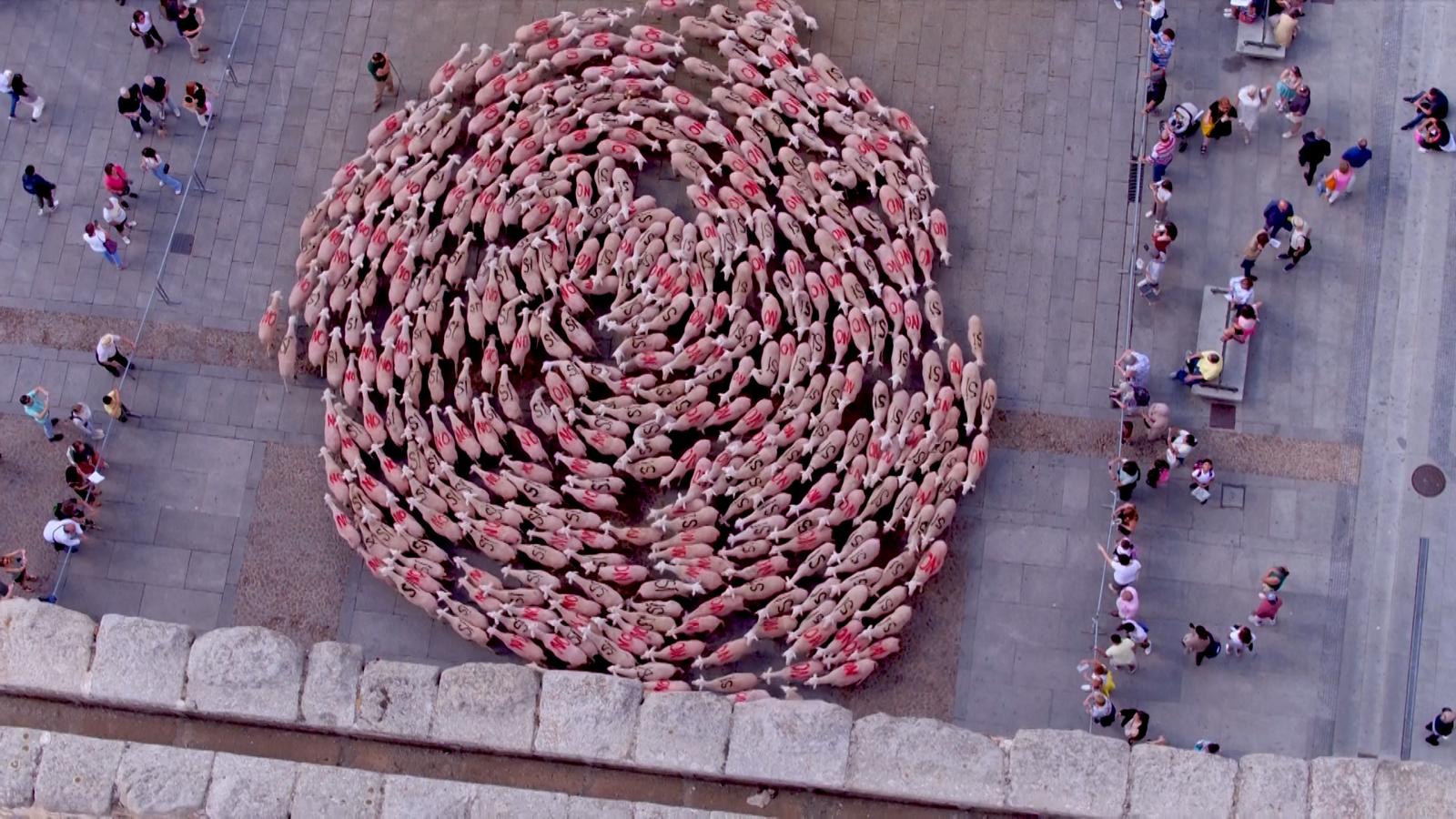
The Sheep of Mr Montes, project by Kate Daudy and Kostya Novoselov, film directed by Luis Mengs, produced by AIDA Association
In Segovia, we demonstrated how fragile a system of living organisms can be. We walked the sheep through the Castilian fields for a full day to bring them into a square in Segovia. Sometimes you can control the sheep, but at the same time they behave as individuals. We were trying to understand how self-organization appears, where is the limit of you being you, and where crowd behavior begins.
Chaos and the Origins of Life
If you take an ordered system and disturb it, making it more random, at some point you reach absolute randomness. The only way forward is to start ordering it again. Unfortunately, we rarely observe the emergence of order. The space of parameters where systems remain chaotic is enormous.
© Shutterstock
Yet we see complex systems, including living systems, that can rectify chaos, randomness and create complexity out of it. We still don’t understand how this works — how complex systems find the exact pathway and how they emerge from this chaotic behavior. Everyone would love to know this. Understanding this pathway may lead us toward understanding the origin of life. But we are still in the dark in that sense.
What Age Do We Live In?
Materials often define the technologies we use at particular stages of development. We speak of the Stone Age, the Bronze Age, the Iron Age. It is worth asking: what age are we living in now?
Labeling the ages we live in can be beneficial because it focuses resources on a particular technology. But it can also limit opportunities. In an ideal world with infinite resources, we would explore many different technologies, many different materials all at once.
© Shutterstock
In reality, resources are limited, and we must focus. That is unfortunate. We would like to escape from these limitations. We would prefer not to choose one dominant technology, but to allow many flowers to flourish.
On the Shoulders of Giants
We often place too much emphasis on the role of one person in the discovery. Breakthroughs do happen because one particular person makes a decisive step. But as Newton said, we stand on the shoulders of giants. It is always the effort of the whole scientific community.
© Shutterstock
It is important to recognize this and recognize the contribution of every single PhD student because they all contribute to our technologies, our science, and our discoveries.
Editor’s note: This article has been faithfully transcribed from the original interview filmed with the author, and carefully edited and proofread. Edit date: 2026
Discover more about
scientific discovery
Novoselov, K. (2010) Nobel Prize Lecture
Novoselov, K. Graphene: Materials in the Flatland. Nobel Lecture, December 8, 2010, School of Physics and Astronomy,
Daudy, K https://katedaudy.com/
Daudy, K. Novoselov, K. (2022) Everything is connected. The Hay Festival Segovia
Daudy, K., Novoselov, K. (2021) Alternative Random Number Generator: The Sheep of Mr. Charles Platt
Daudy, K. Novoselov, K. (2025) Wonderchaos (the book).
Daudy, K. Novoselov, K. Wonderchaos (the project).
Continue exploring




Explore this knowledge network
Continue exploring...
0:00 / 0:00