


A change of paradigm is usually associated with a change in language. Take an example from my own field. Centuries ago, people spoke about insulators and metals to measure how they conducted electricity. Later, we introduced concepts such as band structure, band gaps, and the Fermi level. Today, we talk about the topology of bands. It doesn’t mean we were wrong before. It means we constantly develop better and better language to describe nature. That is how we enhance our understanding and create predictive power in science.
Changing Our Paradigm
You create a new paradigm, one paradigm is replaced by another: this is how scientific discovery works. From graphene to functional materials, progress comes from shifting perspectives and embracing complexity.
Professor of Physics and Material Science
08 Mar 2026
Citation-ready summary
You create a new paradigm, one paradigm is replaced by another: this is how scientific discovery works. From graphene to functional materials, progress comes from shifting perspectives and embracing complexity.
Author: Konstantin Novoselov
Last updated: 08 Mar 2026
Key Points
- Scientific discoveries require the creation of a new scientific language.
- Biological systems distribute functionality across many levels, and learning from this complexity may allow us to create active materials that behave more like living systems.
- The true impact of graphene was not a single application, but the paradigm shift that proved two-dimensional materials can exist and opened an entirely new class of materials.
- AI will become a powerful tool in discovering complex materials, but scientific discovery cannot be forced and will always depend on broad, interconnected knowledge guided by researchers.
A New Scientific Language
What does it mean to do science? And what does it mean to make discoveries? Most often, it is the creation of a different scientific language. The most famous example is probably the wave function — the notion of entanglement in quantum mechanics, or the idea of orbits in the atom nucleus. These are concepts that only exist because we created a special language for them and operate within it.
© Shutterstock
The origin of complexity
The way we currently develop technology would never allow us to fully understand how biological objects operate, or the origin of life, or how to create synthetic systems that behave on a quasi-biological level. We need to learn more from nature and try to make parts of our systems more active — active in their own right — rather than completely passive, as most existing materials are today.
This is what we call the origin of complexity. The functionalities we require from technology are associated with a certain level of complexity. But in most current technologies, functionalities are situated on only one level. Take any functional system — an electronic component, a microprocessor, a robotic system, even a car. Remove one component, and it immediately stops functioning. The complexity, the functionality appears on only one level.
© Shutterstock
In biological systems, complexity and functionality are distributed across many levels. Biological molecules such as proteins have functionality. Cell membranes have functionality. Cells themselves, organs — each level contributes. This distribution allows to achieve far more complex behavior.
That is what we want to learn from nature. We want to delegate certain functions to the material level, so materials could generate energy themselves, perform certain tasks independently, perhaps even make decisions depending on the environment. We are not there yet. But many researchers are working on functional materials today.
Going to the Next Level
We all remember the film Terminator 2, with the robot made of liquid metal — able to change shape, change color, self-heal, and exhibit intelligence. To achieve something like that, functionality would need to arise at many levels, from the basic material level to the intelligent system embedded within it.

© Shutterstock
At the moment, we do not distribute functionality across multiple levels in this way. For me, this question — how to achieve this — is connected to the origin of complexity, and even to the origin of life. We are still very far from providing a decent answer. We may think we understand how our bodies work, and people speak of neuromorphic computing, mimicking the brain. But in reality, we are still far from understanding biological complexity. The term “neuromorphic” can be misleading. We do work on neuromorphic computers here in this Institute, but they are still far from gaining the same level of functionalities and complexity as the biological systems.
The Discovery of Graphene
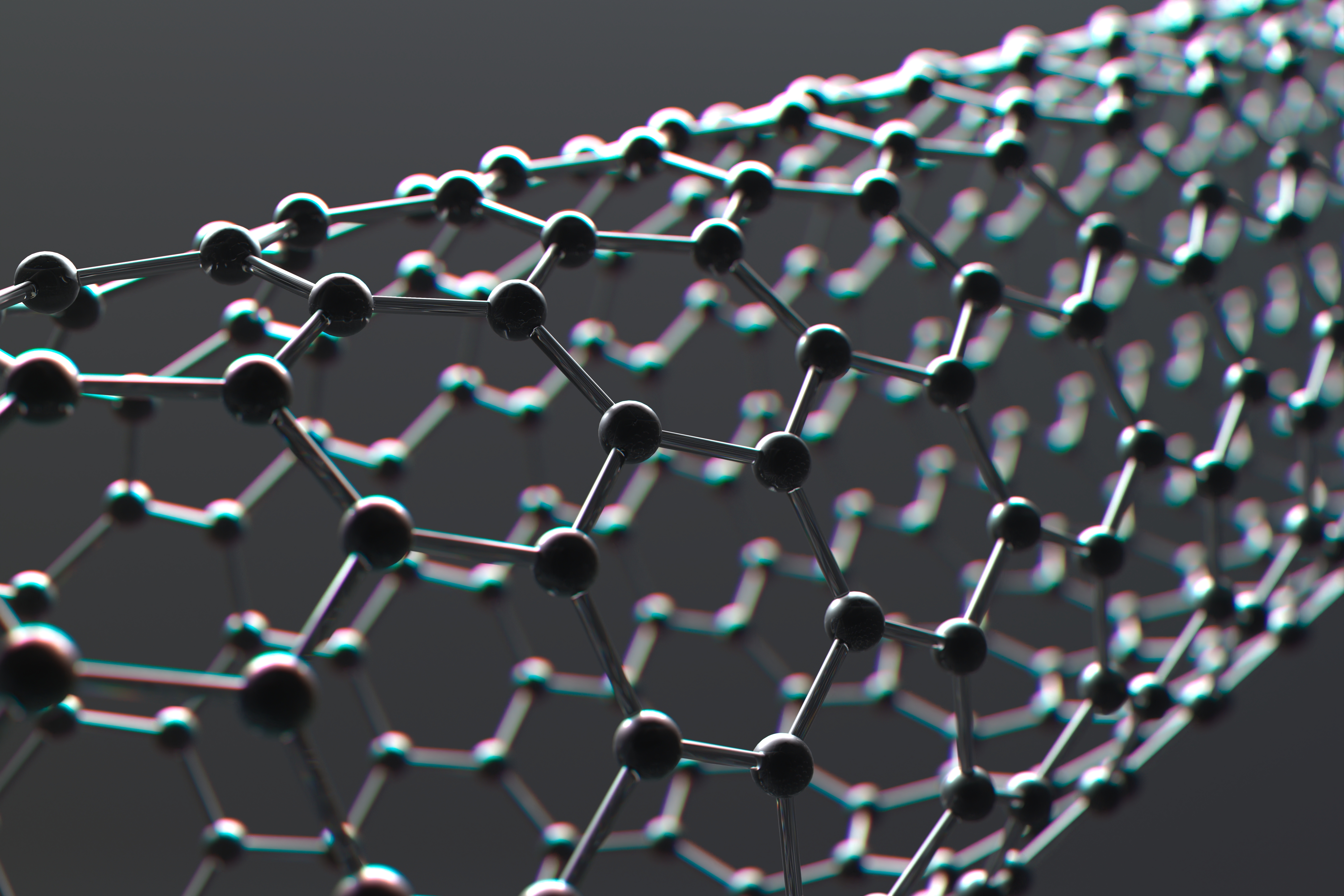
The discovery of graphene was not a single moment; it was a process, a very long process. We spent about a year working with thin graphitic films, studying their quantum properties, before truly understanding what we had. During that year, we did not know much about graphene itself. The only thing we knew for sure was that graphene should not exist.
That shift in perception was extremely important. We figured it out that monolayer materials — two-dimensional, one-atom-thick materials — can exist, be stable, and be studied. And they exhibit unusual quantum mechanical properties.
Computer-generated view of a graphene molecular structure © Shutterstock
This is how scientific discovery works: you create a new paradigm, one paradigm is replaced by another. The paradigm that two-dimensional materials don’t exist, that you can’t arrange atoms in two dimensional crystals was replaced by the realization that they can exist — and that we can work with them.
Friday Evening Experiments
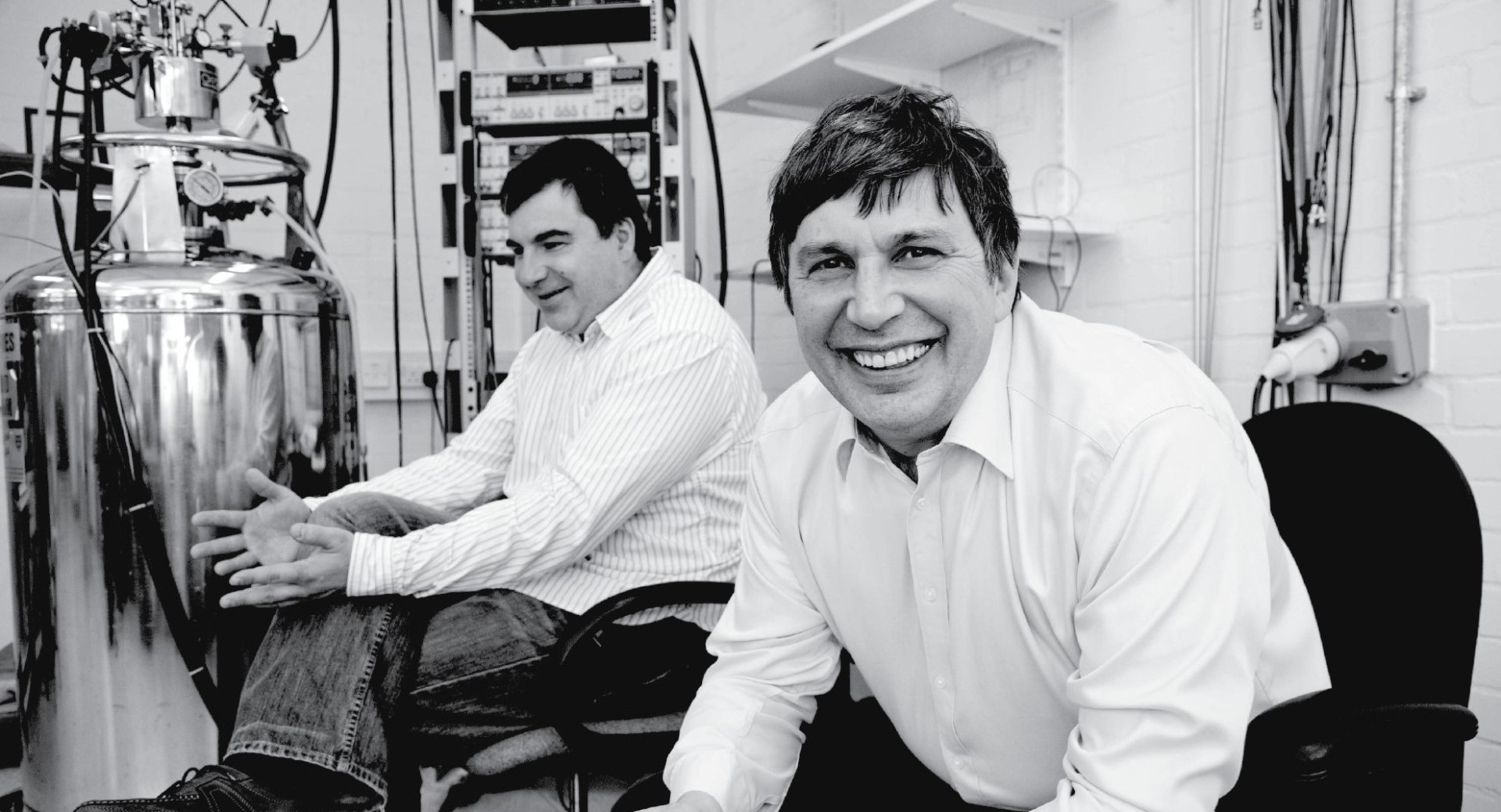
At the time, my supervisor and very good colleague and friend Andre Geim introduced the idea of Friday evening experiments — where you were allowed to mess around a little bit to explore ideas outside our mainstream work. Graphene was one of those ideas.
Professor Sir Kostya Novoselov and Professor Sir Andre Geim © University of Manchester
Andre asked whether we could make a transistor out of graphite. It was obvious that we needed to take a very thin layer of graphite and then try to make a transistor out of it. We tried many approaches, none worked, and we pretty much forgot about it. One day, we were preparing samples for our scanning tunneling microscope. We used Scotch tape to peel the top layer of a graphite crystal — a routine cleaning method. Normally, you throw that away and use only the freshly cleaved crystal. But because we were thinking about this idea of how to make thin graphitic films, we thought: why can’t we try and make a very thin layer with this scotch tape? And the very first device worked! It worked very badly but it worked. That told us we were on the right path. It took another year before we produced our first graphene devices.
Changing Our Paradigm
The most important consequence of graphene discovery - we usually use the term isolation of graphene - was the demonstration that two-dimensional materials can exist and be stable and you can make experiments with those. And it immediately gave a kick to the discovery of many other two-dimensional materials. Graphene turned out not to be alone. There is a whole family of two-dimensional crystals. The most important consequence of graphene is that a whole new class of materials became available to scientists.
Of course, graphene gave rise to many applications. It has found applications in batteries, composite materials and electronics everywhere. But the fact that graphene changed our paradigm, that two dimensional materials can exist, is the most influential consequence of, of that work.
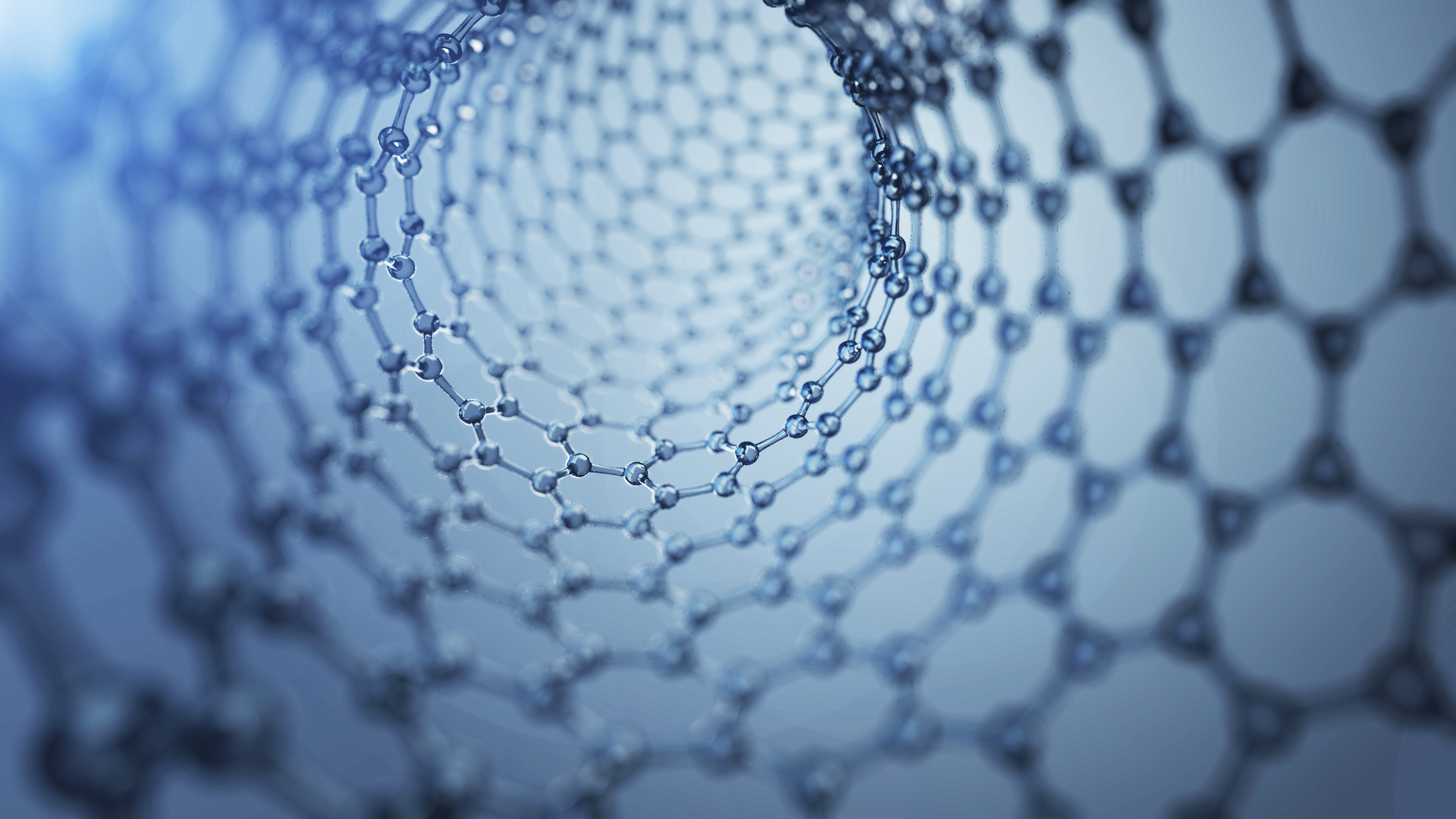
We do not work only with 2D materials, but they introduced a powerful concept: artificial materials, materials on demand. If you have access to these two dimensional crystals which are only one atom thick, you can assemble them with atomic precision into a stack and put one layer of one material, another layer of another material, then another one… And then you basically create a three-dimensional material which didn't exist in nature before.
By combining many different two-dimensional crystals, you can design entirely new artificial materials.
© Shutterstock
Some of these materials can change their behavior depending on their environment. This opens the possibility of creating active materials — materials that communicate with the environment. And the ultimate goal is really the functional materials, which can change their properties, which can react to the external stimuli and maybe just behave as biological materials.
“AI is a tool for us”
With the rise of AI and tools like ChatGPT, many people believe AI will revolutionize many other areas of our life. Of course, researchers try to use AI for the development of new materials. We are only at the beginning of this journey.
© Shutterstock
I am very positive that it’s going to work and AI will become an important tool for the discovery of complex, dynamic materials that can evolve by themselves. We are not there yet. But I still believe that the role of a scientist will be very important. AI is a tool for us. And it's going to be a very powerful tool. But the role of the scientist, of the researcher will still be dominant.
Can You Plan a Discovery?
It is very wrong to think that discoveries can be planned, that you can concentrate resources into one point and force a discovery. That is not how science works.
© Shutterstock
Science really works by accumulating broad knowledge across many areas. These areas strongly cross-pollinate and influence one another.
Science must be developed as one, not as individual silos.
Editor’s note: This article has been faithfully transcribed from the original interview filmed with the author, and carefully edited and proofread. Edit date: 2026
Discover more about
graphene
Geim, A., Novoselov, K The rise of graphene. Nature Mater 6, 183–191 (2007).
Novoselov, K. (2010), Nobel Prize Lecture
Novoselov, K.Graphene: Materials in the Flatland, Nobel Lecture, December 8, 2010 . School of Physics and Astronomy.
The NUS Centre for Advanced 2D Materials.
Daudy, K., Novoselov, K. (2021) Alternative Random Number Generator: The Sheep of Mr. Charles Platt
Daudy, K. Novoselov, K. (2025) Wonderchaos (the book).
Daudy, K. Novoselov, K. (2025) Wonderchaos (the project).
Continue exploring





Explore this knowledge network
Continue exploring...
0:00 / 0:00