Catherine the Great
Catherine the Great has a good claim to be the most consequential Russian ruler in history, and certainly in the Romanov era from the early 17th century through to 1917. To give some idea of the scale of her achievements, consider the challenges that she faced when she came to the throne in 1762. I would say those challenges came in three main categories.
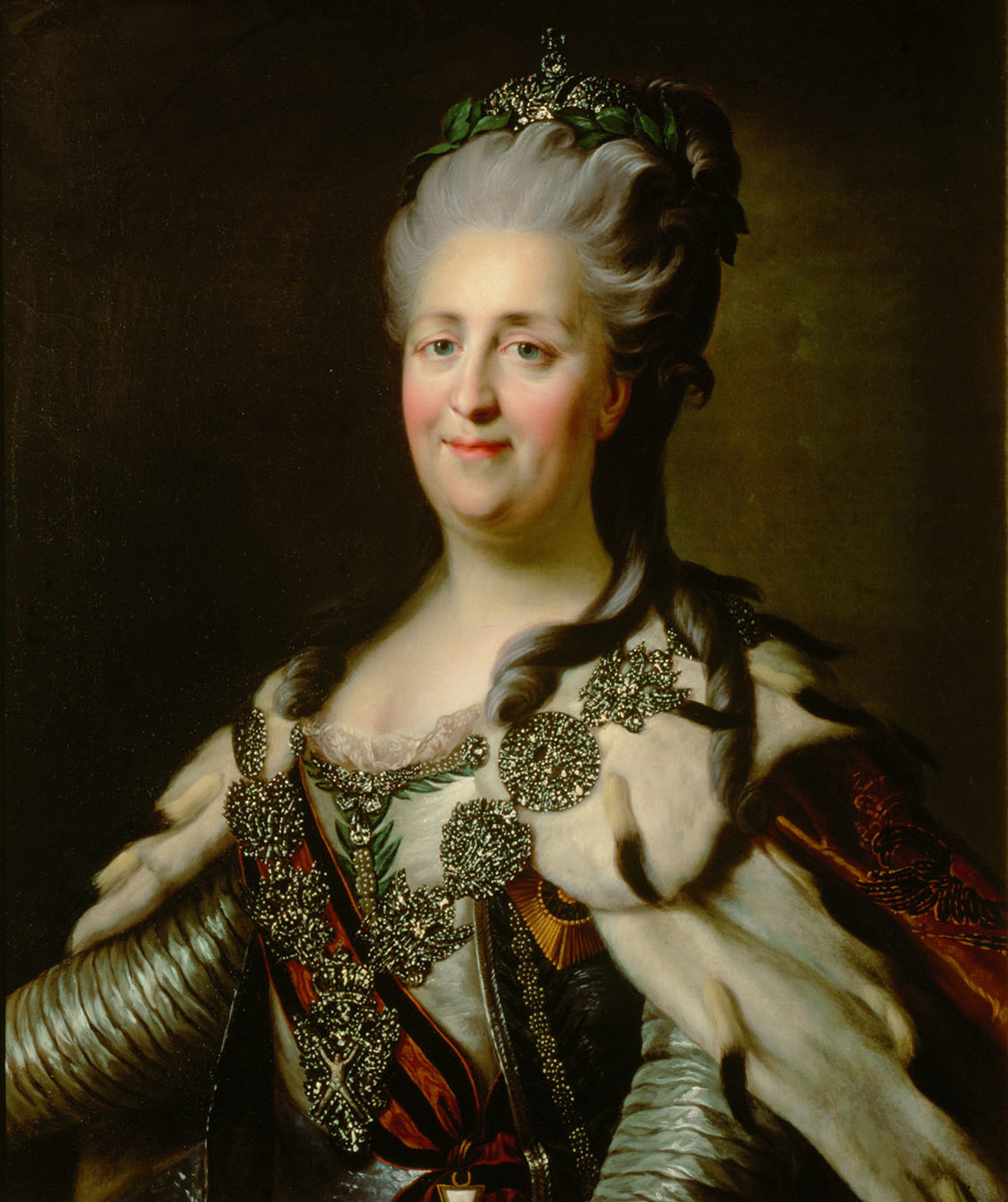
Portrait of Catherine II of Russia, 1780s, © Wikipedia
The first was her own power and authority. All politicians worry about their power, but Catherine had particular reasons to do so because she was a minor German princess who had become Empress of Russia after the murder in a palace coup of her own husband, Peter the Third. There was every reason to believe that her authority was going to be shaky, at least in the short term.
The second area of difficulty was geopolitics. When Catherine came to the throne, Russia was emerging from the Seven Years' War, which had taken it deeper into European great power politics than ever before.
Finally, the third area was governance. Russia developed very rapidly in territorial terms from the late 15th century through to Catherine's time. But it was still a state with pre-modern communications, and governing it effectively over these huge territories was enormously difficult. Catherine's task was to find some new solution.
A new rational order
What's striking about Catherine is not just that she engaged in the usual maneuvers and machinations that politicians do, but also that she advanced a very public, powerful vision of the state that she wanted to achieve. In 1767, near the beginning of her reign, she summoned a legislative commission to work on drawing up a unified code of laws for the Russian Empire, something that Russia had sorely lacked for a long time. Not only that, she wrote an instruction, a Nakaz, to accompany the Legislative Commission and guide its deliberations.
This document helped with the three challenges Catherine faced. First, the Legislative Commission bolstered her authority. On the one hand, in her Nakaz, she came about with enlightened sentiments on the need for a rational system of punishment and equality before the law. On the other hand, she made absolutely no bones about the absolute nature of her own power.
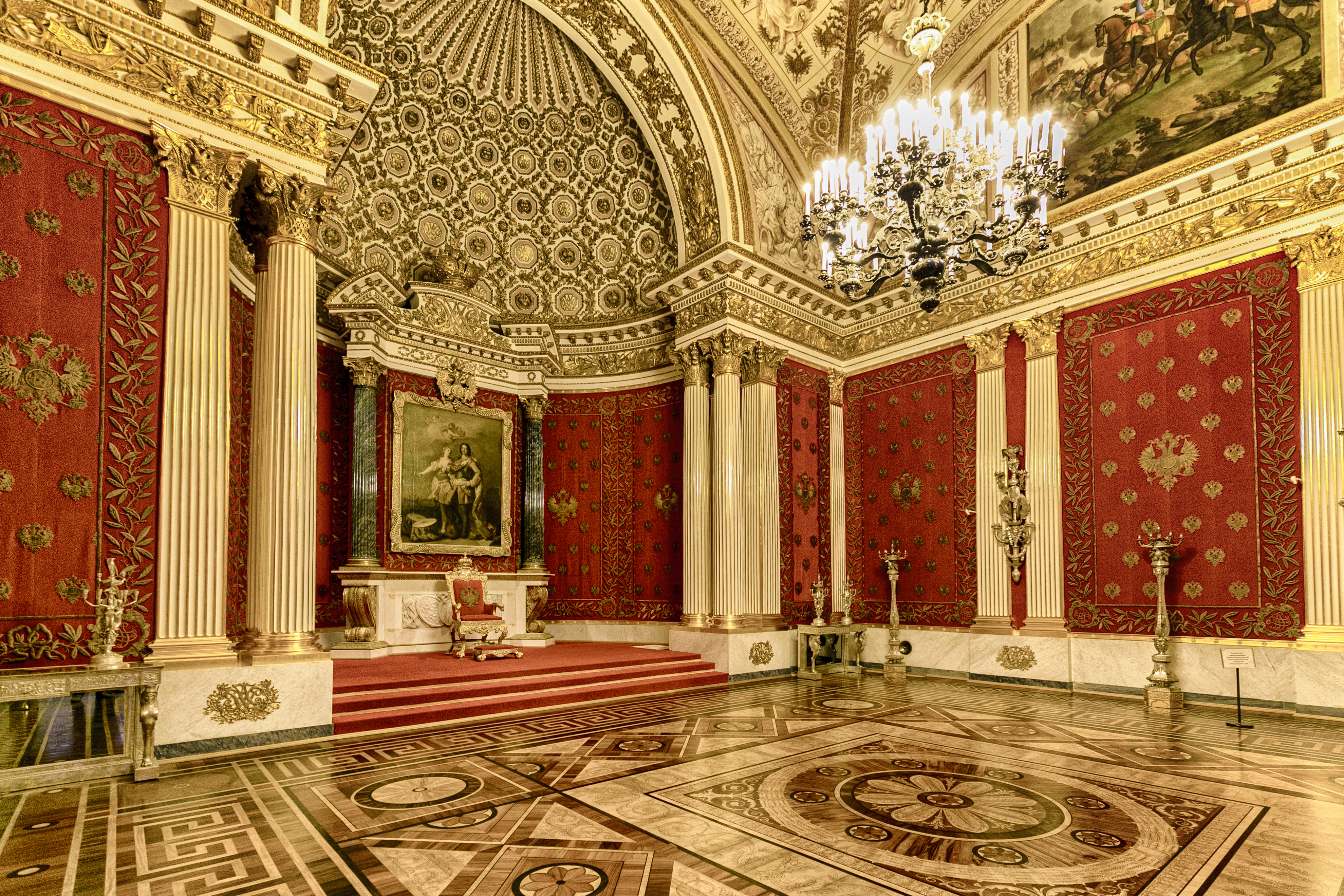
The throne of Empress Catherine II of Russia, © Wikipedia
Secondly, on geopolitics, she was saying Russia is no longer an Asiatic backwater. It is an enlightened, modern European state on a par with its peers. Famously, the very first line of the first chapter of the Nakaz says "Russia is a European state".
Thirdly, when it comes to the challenges of governing the empire, this enlightenment position helped because it provided order and regularity. Enlightenment in Catherine's version was not about representation or democracy; it was about rational order in the interests of authority.
Imperial Elections
Many people have said that the legislative commission was just a propaganda exercise, but I think it's more significant than that. Perhaps above all because it extended and regularized the system of elections. The 560 odd delegates to the legislative Commission were largely elected from all over the empire.
Certainly, serfs took no part. But peasants of other kinds did, and non-Christians were also entitled to vote, as long as they were deemed to be non-nomadic. The elections to the Legislative Commission also introduced, on a wide scale, a voting procedure known as the ballot, or ballotirovka in Russian. This was a labour-intensive method in which each candidate was voted on in turn. Each voter would take a ball and place it on one side or the other of a partitioned box—either yes, in favour of the candidate, or no, against. This voting method had been brought to Russia by Peter the Great in the late 1710s, but it was only widely applied and made standard for nobles and townspeople under Catherine.
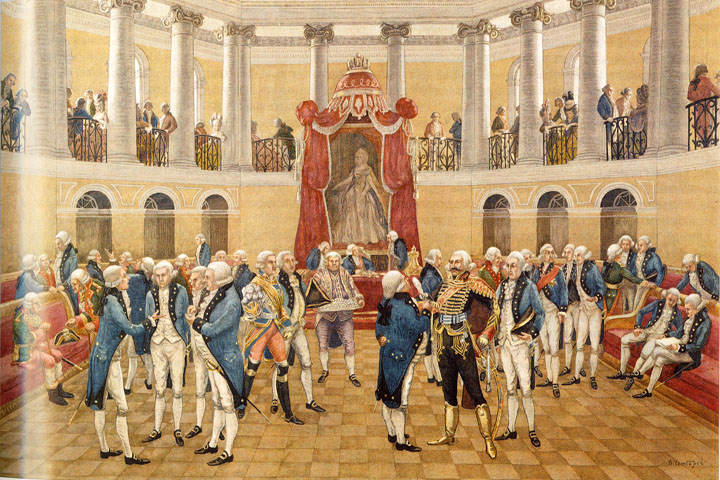
A gathering of the nobility during the reign of Catherine II, by Vladimir Chambers (1913), © Wikipedia
These elections helped enormously with the task of imperial governance. For one thing, they imposed a system of social categories where people voted as members of particular status groups that the state defined. As well as introducing social categories, elections performed an incredibly useful role because they provided office holders for the Imperial state. This was the way of recruiting administrators for this notoriously under-governed pre-modern Russia. We have a paradox here: elections that we think of as the path to democracy were performing the role of maintaining imperial authority and staffing the administration at the local level. This principle continued all the way through to 1917.
The dam bursts
But after 1861, when the serfs were emancipated, people were on the move in all kinds of ways, and the estate system really didn't match social realities. Above all, if you give a particular socioeconomic or ethno-confessional group the vote, they start to think of themselves as distinct groups with interests different from those of the empire.
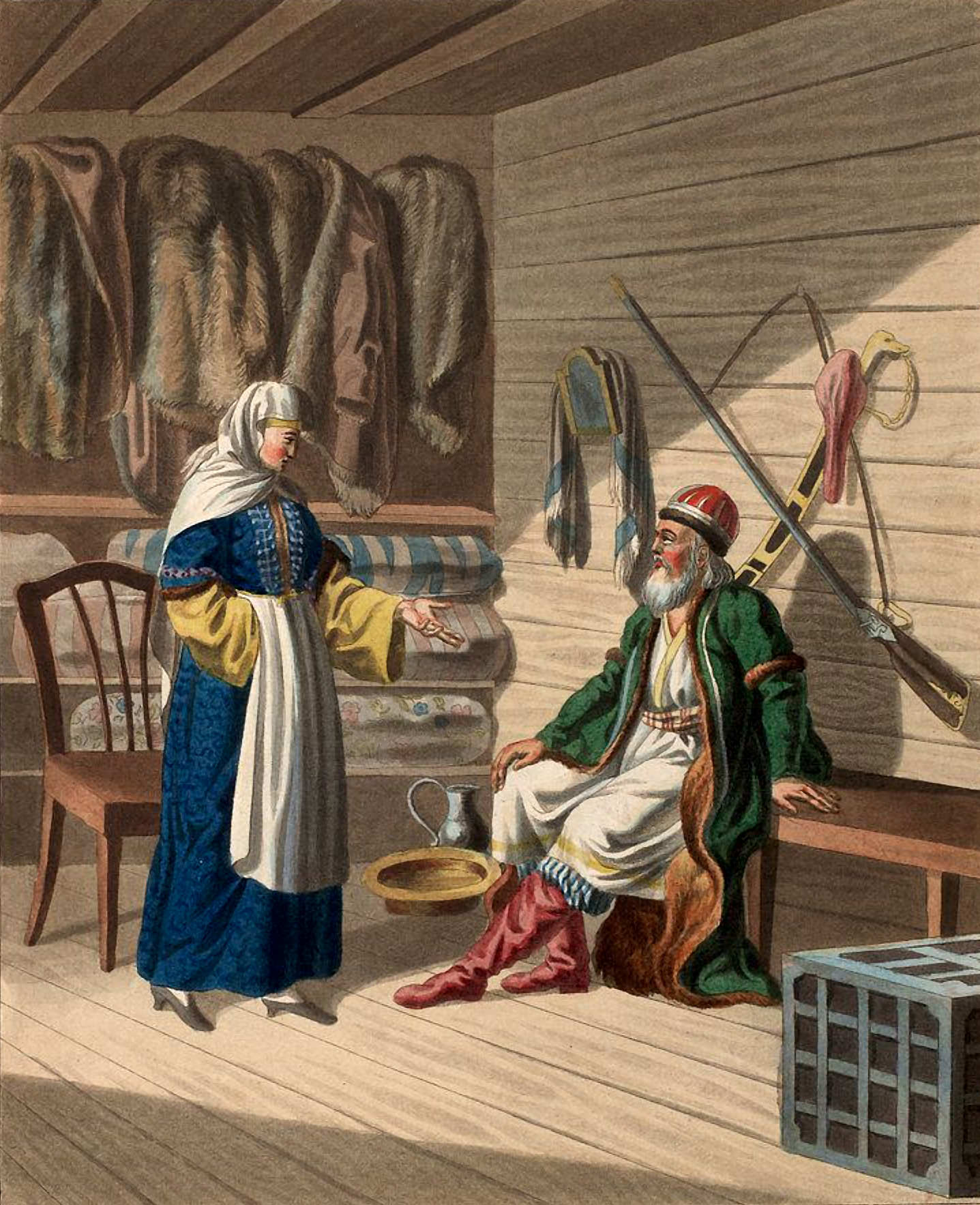
Cossacks of the Terek, illustration from the album The Peoples of Russia by Emelian Korneev, 1812, © Wikipedia
By the 1890s in municipal politics, and even more so in the State Duma after 1906, you get increasing levels of antagonism between different social classes and ethnic groups, whether between Armenians and Georgians or Germans and Estonians. That goes through all the way to 1917 when the efforts of the tsarist regime to keep things under control fail completely. There was a revolution, the dam burst, and all of these classes and ethnic groups were competing with each other. They also had competing notions of what representation should be, and it took the Bolsheviks to come along and impose by force their own version of imperial elections.
A European great power
By the time Catherine died in 1796, her mission to turn Russia into a European state had been a success if you measure it by territory. Catherine presided over three partitions of Poland. Although the amount of territory gained was not as great as expansion into Siberia in the 17th century, you could argue this was the most consequential set of acquisitions. Moving into Poland brought Russia much closer to the center of European politics and turned it into a European great power.
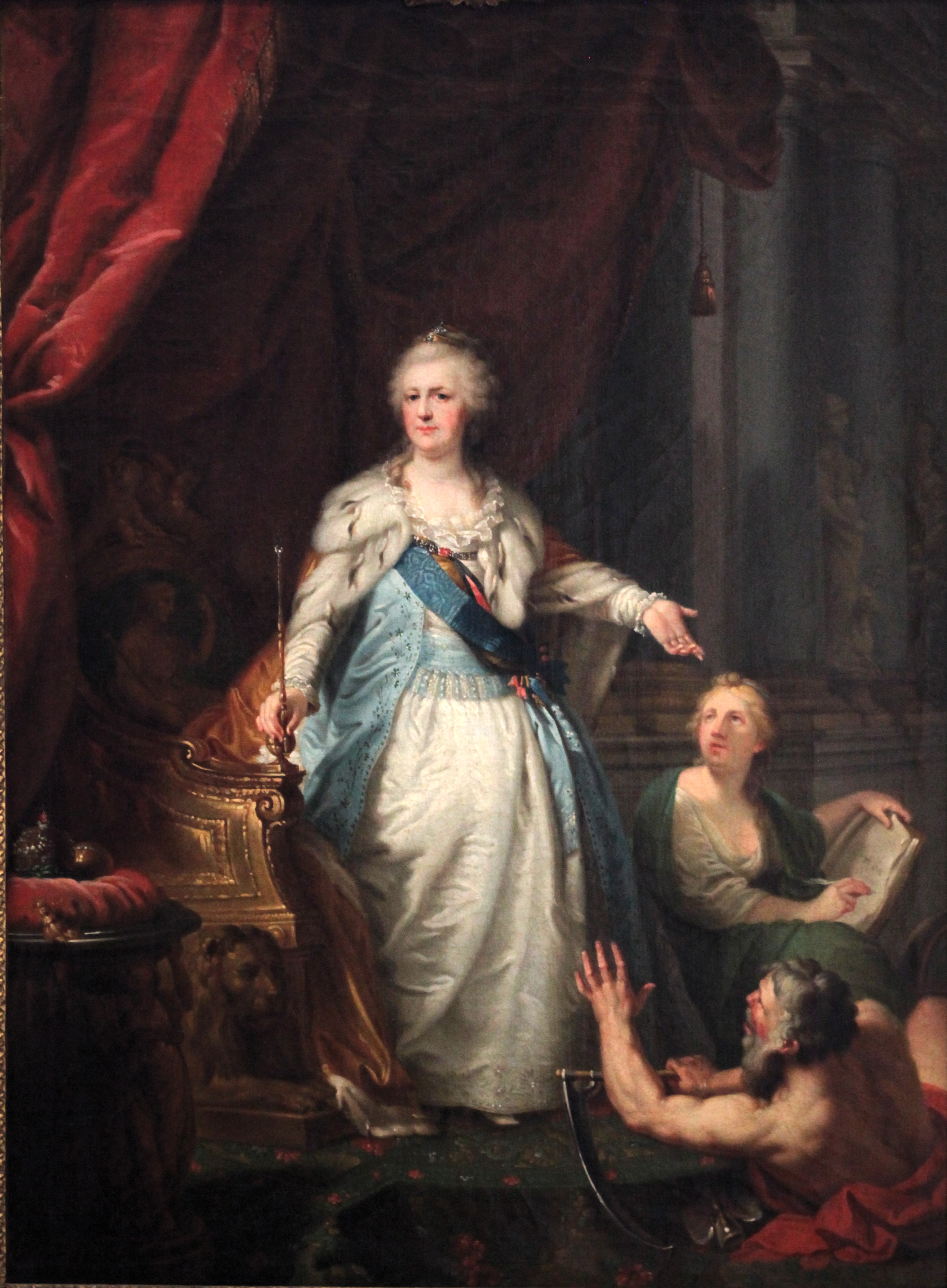
Portrait of Catherine II of Russia, © Wikipedia
But success in those terms brings a new level of risk and vulnerability. Russia was, you might argue, overextending, trying to impose its rule on territories that did not want to receive it and making its population far more diverse. This diversity included groups of people who already had well-established political and social systems and were going to find ways to push back against the Russian Empire.
Editor’s note: This article has been faithfully transcribed from the original interview filmed with the author, and carefully edited and proofread. Edit date: 2026
Discover more about
The building of Imperial Russia
De Madariaga, I, (1981), Russia in the Age of Catherine the Great.
Dixon, S, (1999), The Modernisation of Russia, 1676-1825.
Jones, R E, (1973), The Emancipation of the Russian Nobility, 1762-1785.
Lovell, S, (2026), Voting in the Graphosphere: Elections in the Russian Empire. Slavic Review, forthcoming.