


Clouds on Earth are made of water vapour condensing into droplets of water, or, in very cold parts of the atmosphere, into crystals of ice. On Earth, it's water all the way up.
Alien clouds
Exoplanet research has revealed that atmospheres far beyond our solar system are filled with truly alien clouds. By studying these extreme environments, we can better understand the fundamental physics and chemistry that control energy and climate, providing vital insights into the past, present, and future of our own Earth's atmosphere.
Associate Professor of Astrophysics
12 May 2026
Citation-ready summary
Exoplanet research has revealed that atmospheres far beyond our solar system are filled with truly alien clouds. By studying these extreme environments, we can better understand the fundamental physics and chemistry that control energy and climate, providing vital insights into the past, present, and future of our own Earth's atmosphere.
Author: Hannah Wakeford
Last updated: 12 May 2026
Canonical URL: https://www.joinexpeditions.com/exps/1415-alien-clouds
Key Points
- Clouds on hot exoplanets are not made of water but of minerals like rock, quartz crystals, and even molten iron.
- The giant puffy planet WASP-17 b contains tiny nanocrystals of quartz that circulate in a cycle of vaporization and condensation.
- Clouds control a planet's energy balance by reflecting sunlight (albedo) and absorbing outgoing heat, which dictates the overall environment.
- Studying the fundamental particles in alien atmospheres helps scientists understand the influence of similar materials on Earth, such as volcanic ash and Saharan dust.
- Looking at other worlds reinforces the reality that there is "no planet B"; we must understand and take care of the Earth's fundamental atmospheric structure.
Clouds on Exoplanets
When we look at exoplanets — planets that orbit stars other than the Sun — one of the first things we found is that their atmospheres contain clouds.
But many of the exoplanets we've discovered orbit incredibly close to their stars. Because they are so close, they are much hotter and exposed to intense radiation from the star itself. It's like sitting closer to a fire — you can feel the difference in heat.
If we heat up a planet enough, it's no longer going to make clouds out of water vapour because it's too hot for water to become either liquid or solid ice.
So the big question becomes: what are the clouds made of in a hot exoplanet atmosphere?
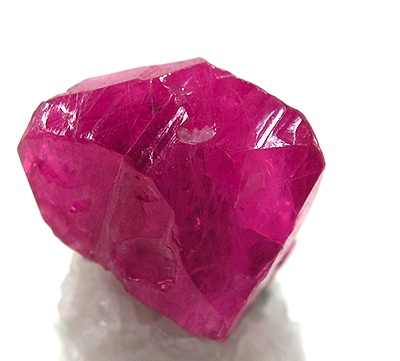
Corundum. © Wikimedia
One of the remarkable things we've discovered, through studying objects across the universe and understanding the chemistry of materials here on Earth, is that the clouds forming in these giant hot exoplanet atmospheres are actually made of rock.
They can be made of quartz crystals, molten iron, or even corundum — the material that forms rubies and sapphires on Earth. These tiny particles suspended in a gas are what we call aerosols, and that's essentially what clouds are.
When we look at these other worlds, we are looking at truly alien clouds and asking: what does that mean, and why does it matter?
A Planet Called WASP-17b
One of the planets where we are studying these alien clouds is called WASP-17b. To get there, we would need to travel around 1,000 light years in the direction of Sagittarius.
WASP-17b is, in my opinion, a beautiful gas giant planet. It has about half the mass of Jupiter but twice the size, which means it has a very low density. If you could find a bathtub big enough, it would float.
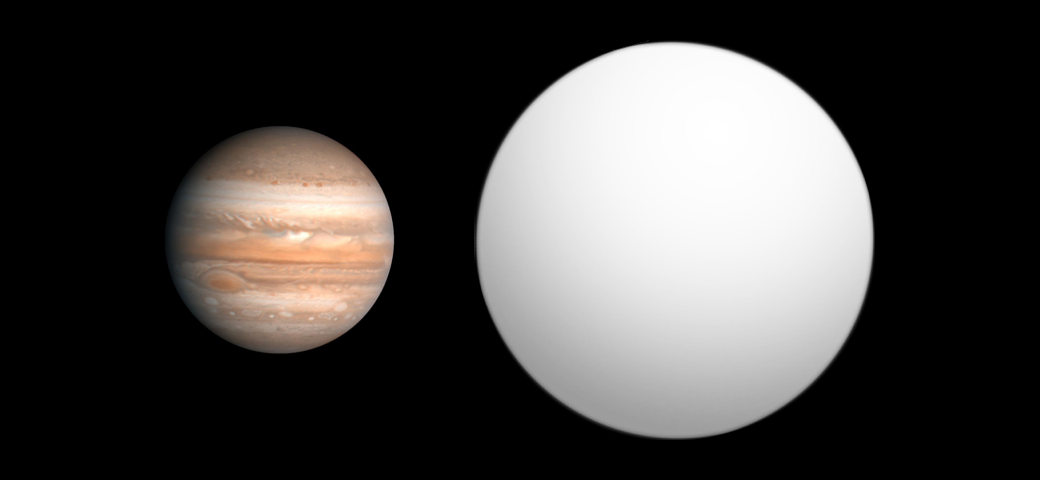
Comparison of best-fit size of the exoplanet WASP-17 b with the Solar System planet Jupiter. © Wikimedia
It's a huge, puffy planet with a very extended atmosphere. When the planet passes in front of its star from our point of view — what we call a transit — some of the starlight passes through the planet's atmosphere before reaching our telescopes.
Because the atmosphere is so extended, a large amount of starlight travels through it, allowing us to measure its atmospheric properties very carefully and very precisely.
One of the remarkable things we measured with the Hubble Space Telescope early on was that the atmosphere scattered blue light more strongly than red light.
That told us there must be very small particles floating in the atmosphere — particles that scatter blue light efficiently but not red light.
We knew there were tiny particles suspended in the atmosphere, but we couldn't initially determine what those particles were made of.
The Infrared Universe
It wasn't until the launch of the James Webb Space Telescope in 2021 that we were able to look properly into the infrared universe.
This matters because if clouds are made of minerals like rock or sand, rather than gases such as water or carbon dioxide, you need to observe them in the mid-infrared wavelengths. That's where those materials interact most strongly with light.
Using JWST, we observed the atmosphere of WASP-17b and detected absorption features that we then tried to reproduce with our atmospheric models.
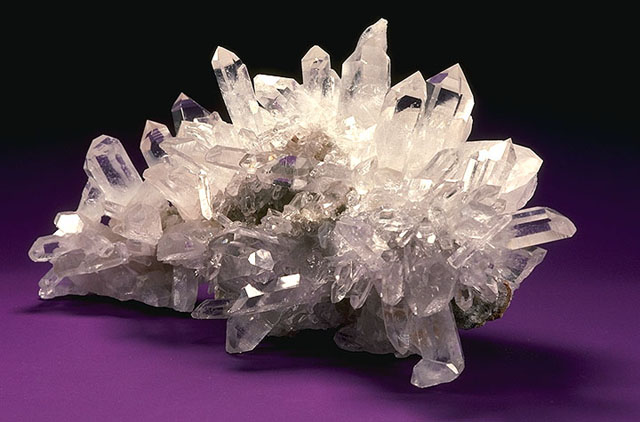
Mineral Quartz Crystal. © Wikimedia
At first, we expected the clouds to be made of magnesium silicates — essentially a form of sand. But instead, we found a signature corresponding to pure silica, without magnesium.
In other words: quartz crystals.
By combining data from the Hubble Space Telescope and JWST, we were able to show that in the superheated atmosphere of WASP-17b — where temperatures exceed 2,000°C — tiny nanocrystals of quartz are circulating through the atmosphere at enormous speeds.
One side of the planet is intensely heated by its star while the other faces the cold of space. This creates powerful atmospheric circulation: rock vapour forms on the hot dayside and condenses on the cooler side of the planet.
WASP-17b has an entire atmospheric cycle of vaporising and condensing rock, forming crystals of quartz in its atmosphere — and we were able to detect the signal of those crystals in the planet's spectrum.
Looking at Clouds
One of the reasons we study clouds is because they fundamentally control how energy enters and leaves a planet.
On Earth, our bright white water clouds scatter sunlight back into space. This reflectivity is what we call albedo.
If a surface has an albedo of one, it reflects all incoming light. If it has an albedo of zero, it absorbs all incoming light.
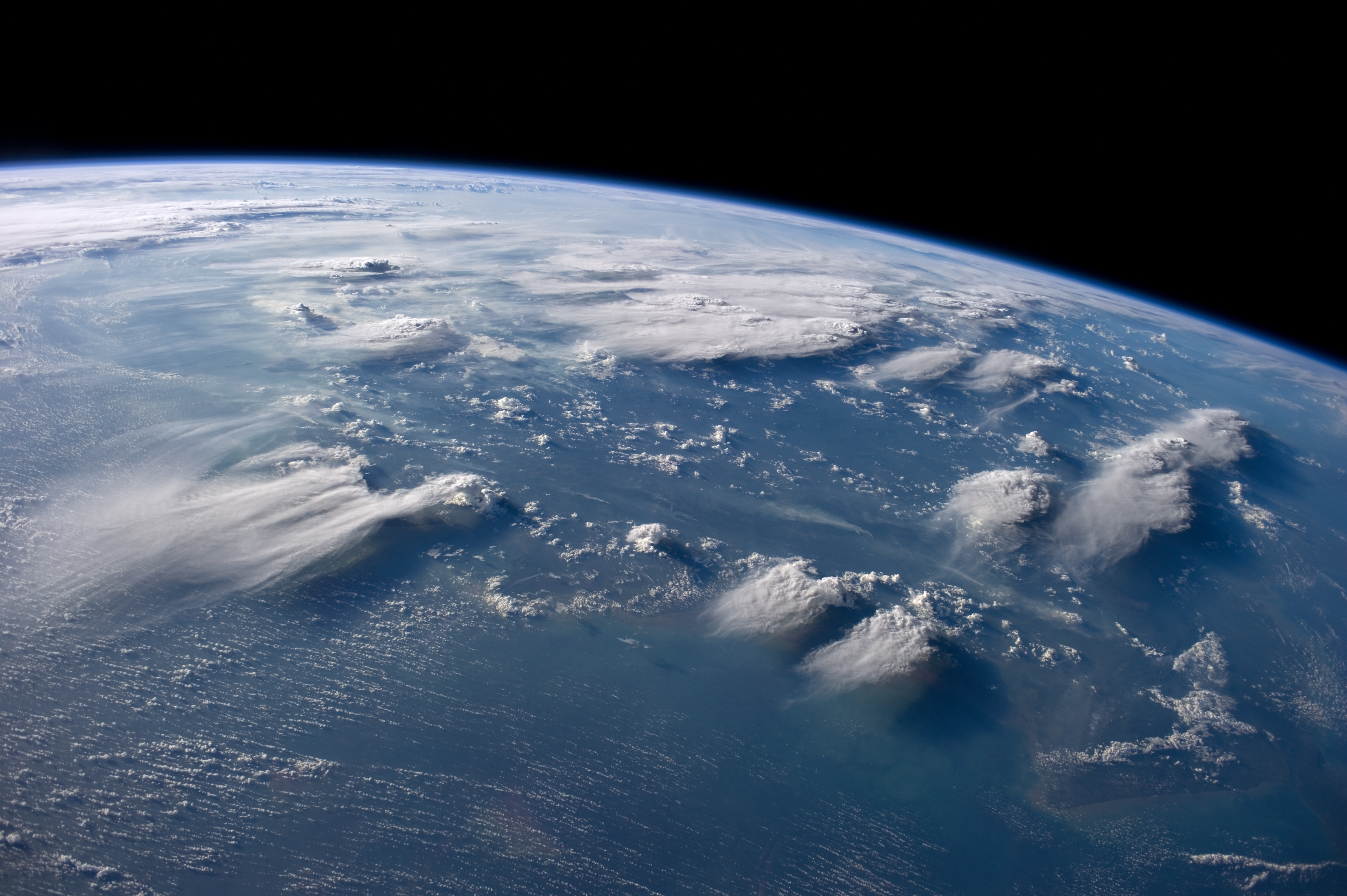
Cloudscape over Borneo. © Wikimedia
But clouds also play another role, depending on what they are made of.
Earth's clouds are made of water, which is also a greenhouse material. Water absorbs infrared radiation — heat. So while clouds reflect sunlight and help cool the planet, they also trap heat escaping from Earth's surface, warming the planet at the same time.
Clouds therefore play a major role in controlling a planet's overall environment because they influence both its reflectivity and its heat balance.
When we study clouds on other worlds — clouds made of materials like quartz — we are asking how those clouds change the transfer of energy through the atmosphere.
How do they influence storms? How do they affect atmospheric circulation? How do they shape climate?
These questions become especially important when we eventually begin studying smaller rocky planets similar to Earth.
If we do not understand how clouds interact with radiation, we will not be able to understand what the environment of any planet is truly like.
An Earth-Like Planet
We are still decades away from being able to study truly Earth-like planets in detail — planets similar in size to Earth or Venus, where we can determine the nature of their atmospheres.
But by studying giant exoplanets orbiting close to their stars, we can already begin to measure the influence of clouds on atmospheric environments.
This allows us not only to refine the observational techniques we will one day use on Earth-like worlds, but also to test the fundamental physics and chemistry operating in these alien environments.
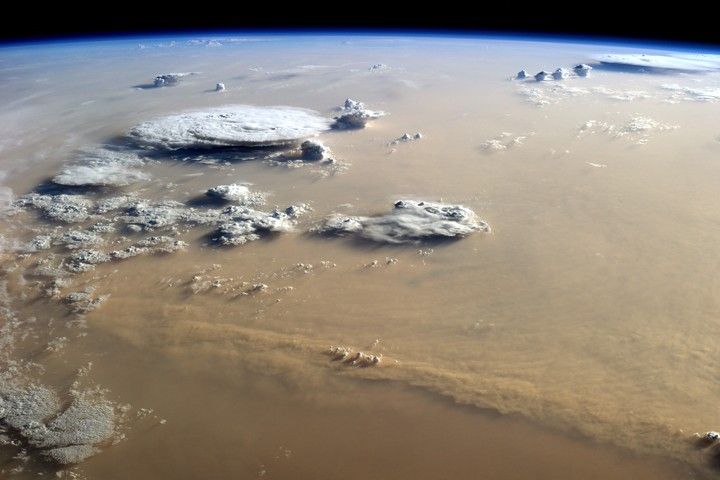
Saharan Dust Storm. © NASA
By studying these giant planets, we are beginning to uncover the basic physical and chemical processes that shape atmospheres throughout the universe.
And ultimately, that knowledge helps us better understand Earth's own atmosphere.
The same quartz particles we observe on distant planets are materials ejected by volcanoes on Earth. Dust particles in our atmosphere influence climate, light scattering, and even the colour of sunsets.
Studying these particles in other worlds allows us to better understand the influence they may also have on our own planet.
No Planet B
I spend all my time looking at other planets.
One of the most fundamental lessons that has taught us is that there is no Planet B.
Earth is our world for many generations, centuries, and millennia to come. What we do to our planet has a profound influence on its atmosphere.
We therefore need to understand how the changes we make alter the balance of energy entering and leaving our planet.
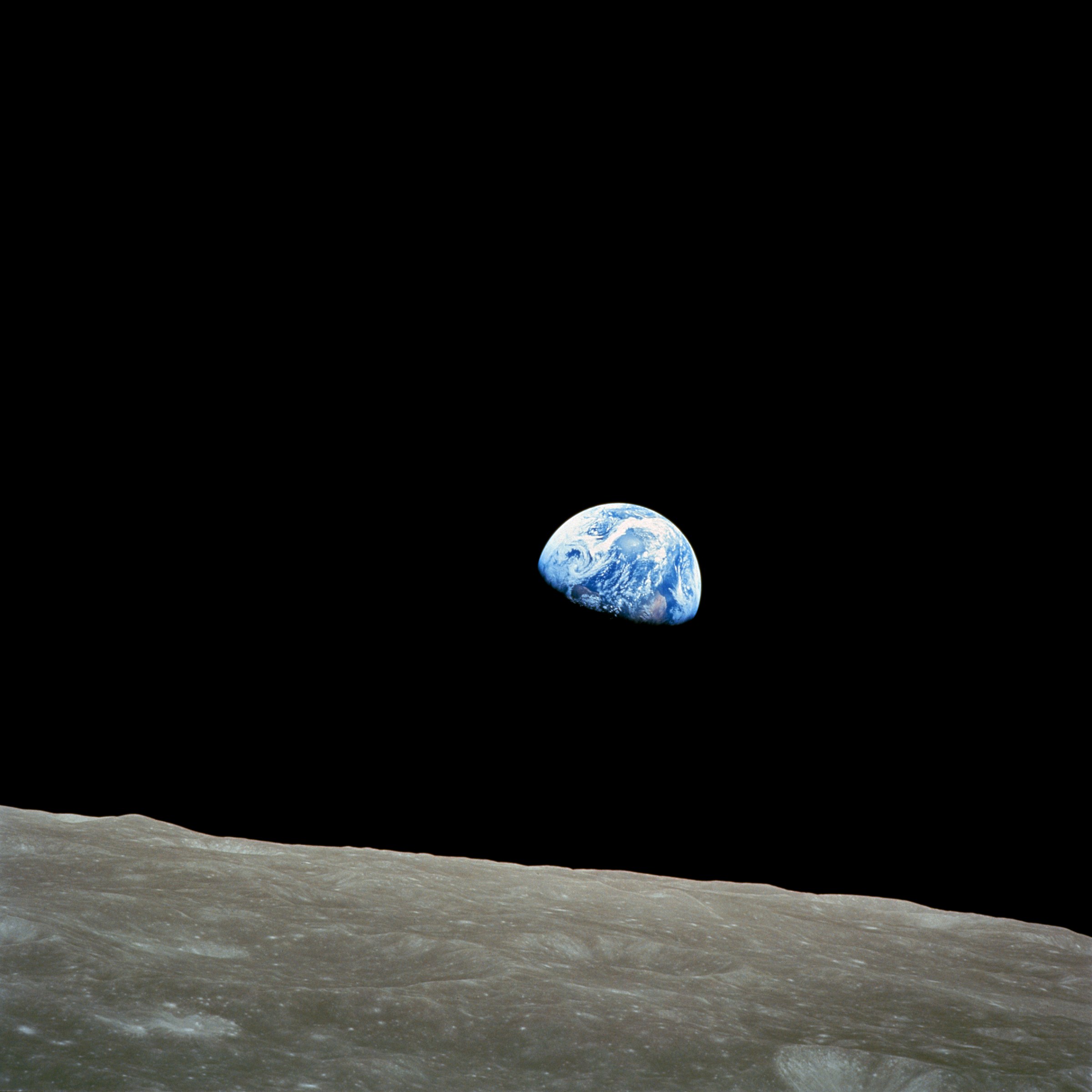
Earthrise, taken on December 24, 1968, by Apollo 8. © Wikimedia
There is nowhere else for us to go. We need to take care of this one.
And if studying other worlds can help us better understand those influences, then that knowledge becomes incredibly valuable.
In the end, it all comes back to Earth — and to understanding our place in the universe.
Editor’s note: This article has been faithfully transcribed from the original interview filmed with the author, and carefully edited and proofread. Edit date: 2026
Discover more about
Alien Clouds
Wakeford, H R, Stevenson, K, Lewis, N K, Sing, D K et al, (2017), HST PanCET program: A Cloudy Atmosphere for the Promising JWST Target WASP-101b. The Astrophysical Journal Letters ,Volume 835, Issue 1, article id. L12, 6 pp.
Wakeford, H R, Visscher, C, Lewis, N K, Kataria, T et al, (2017), High temperature condensate clouds in super-hot Jupiter atmospheres. Monthly Notices of the Royal Astronomical Society , Volume 464, Issue 4, p.4247-4254.
Wakeford, H R, (2015), Cloudy with a chance of water: Observations and analysis of hot Jupiter exoplanet atmospheres. PhD in Physics, Doctoral Thesis, University of Exeter.
Wakeford, H R, (2023), Clouds of quartz. The Conversation, October 18.
Continue exploring





Explore this knowledge network
Continue exploring...
0:00 / 0:00