


The Franco-Prussian War was actually a worldwide conflict, in a sense, and a European conflict in reality.
War and compassion
From the battlefields of the 19th century to today’s wars and humanitarian crises, this conversation opens vital reflections on how modern compassion was invented, organised, and politicised — and why preserving humanitarian archives may be essential to protecting humanity itself.
Professor of Cultural History
01 Jun 2026
Citation-ready summary
From the battlefields of the 19th century to today’s wars and humanitarian crises, this conversation opens vital reflections on how modern compassion was invented, organised, and politicised — and why preserving humanitarian archives may be essential to protecting humanity itself.
Author: Bertrand Taithe
Last updated: 01 Jun 2026
Canonical URL: https://www.joinexpeditions.com/exps/1420-war-and-compassion
Key Points
- Modern compassion in response to war requires more than care. It emerged alongside the development of journalism to create awareness, and banking systems capable of transferring financial aid across borders.
- The Red Cross Movement was founded on the conviction that we should not simply witness atrocities, but act upon them. This mobilisation and activism helped transform the Red Cross within a few years into a powerful international organisation.
- Humanity, neutrality, impartiality, and independence are the four principles adopted in 2001 by the United Nations General Assembly as the fundamental principles of humanitarianism. But humanitarian aid is never naïve — it is deeply political, shaped by negotiations, military realities, and global power structures.
- Humanitarian archives preserve the memory of suffering, violence, and care — without them, communities, crimes, and histories can disappear.
Bloody war
The link between modern war and what we would call modern compassion or compassionate response to the effects of modern war is actually quite complex and quite difficult to trace back in time. I think I make the case that you cannot have the kind of compassion, or the expression of compassion, that we associate with responses to war today without taking into consideration both the communication tools that we use — so basically the appearance of media, media reporting, journalism in the mid-19th century — but also banking, the transfer of funds, the ability to respond to a crisis abroad. Compassion is composed, if you want, not only of something outrageous that makes you unhappy and makes you want to respond forcefully, but also the ability to do something.
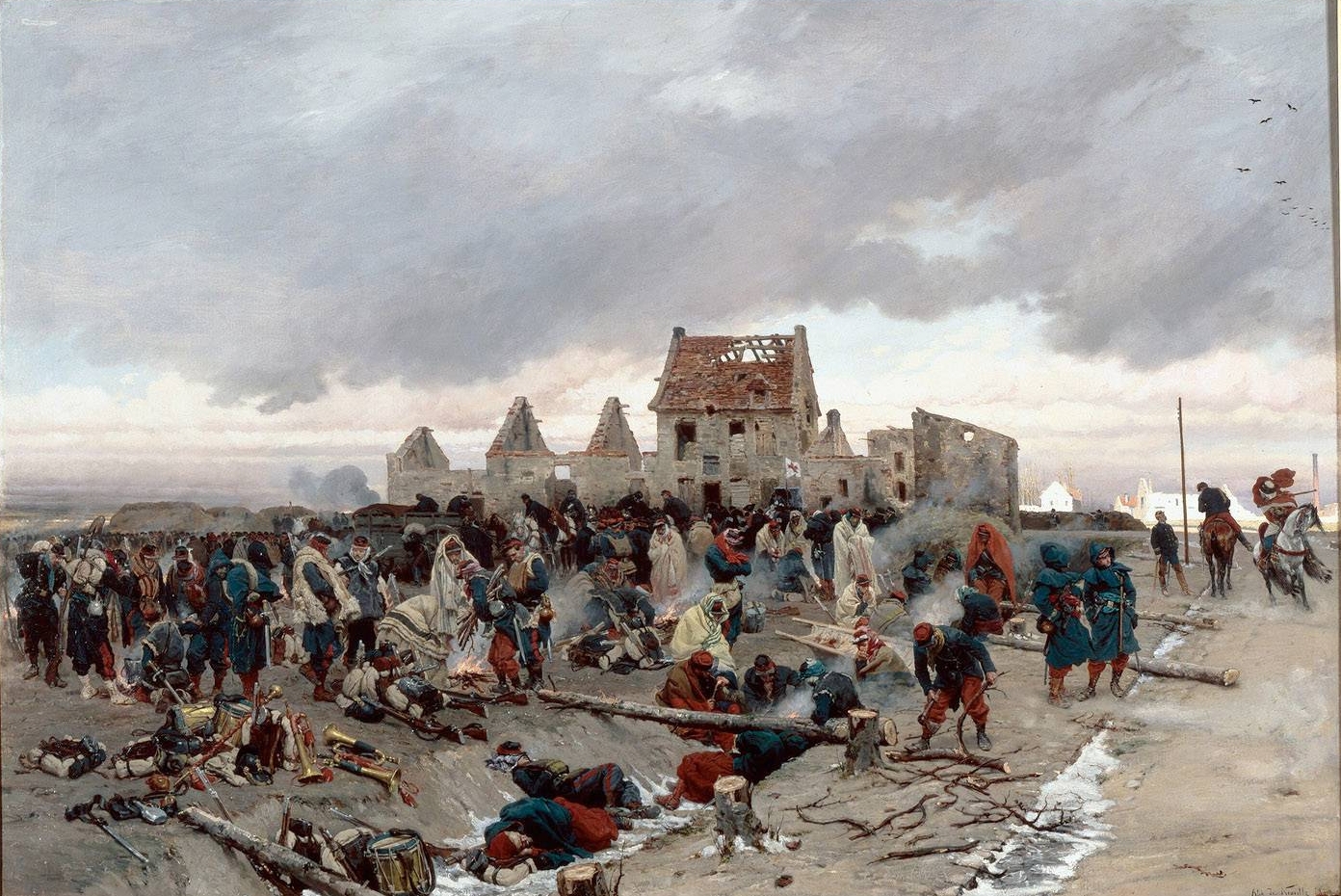
Bivouac après le combat du Bourget, 21 décembre 1870, tableau d'Alphonse de Neuville. © Wikimedia
Now, this is a war started by the French which ended very badly for the imperial regime. It moves very quickly into becoming a sort of popular war, a war of the French Republic against the German states, unified, and eventually unified Germany will be the winner of this conflict. It's a conflict that matters enormously for European and global history because, of course, it's at the roots — the deep roots — of the First World War on the one hand, at least this Franco-German rivalry that we see again in 1914 and that we witness again, of course, in 1939. It has that direct link. It's also a conflict that brings together belligerents using increasingly deadly weapons. The shift in technology between the early 19th century and the late 19th century is extremely visible. It's an extremely bloody war. In a sense, like the American Civil War just a few years before in the 1860s, you see really important mass casualties among conscript armies or armies of volunteers — young people. It's a war that reaches every family in France or in Germany.
The Red Cross
The Franco-Prussian War also matters because it takes place some eight years or so, or seven years, after the creation of the Red Cross movement on the one hand, and the signing of the Geneva Convention. It follows another war that the French and the Italians had led against the Austro-Hungarians: the war of Italian unification in 1860.
Now, during that conflict, Henry Dunant, the founder of the Red Cross movement — a businessman looking for patronage — basically accidentally bumped into a slaughterhouse, which was the aftermath of the Battle of Solferino. The Battle of Solferino was an extremely bloody battle, and the Swiss gentleman actually encountered suffering on a massive scale and became aware of the inadequacy of the military services to look after those young wounded bodies.
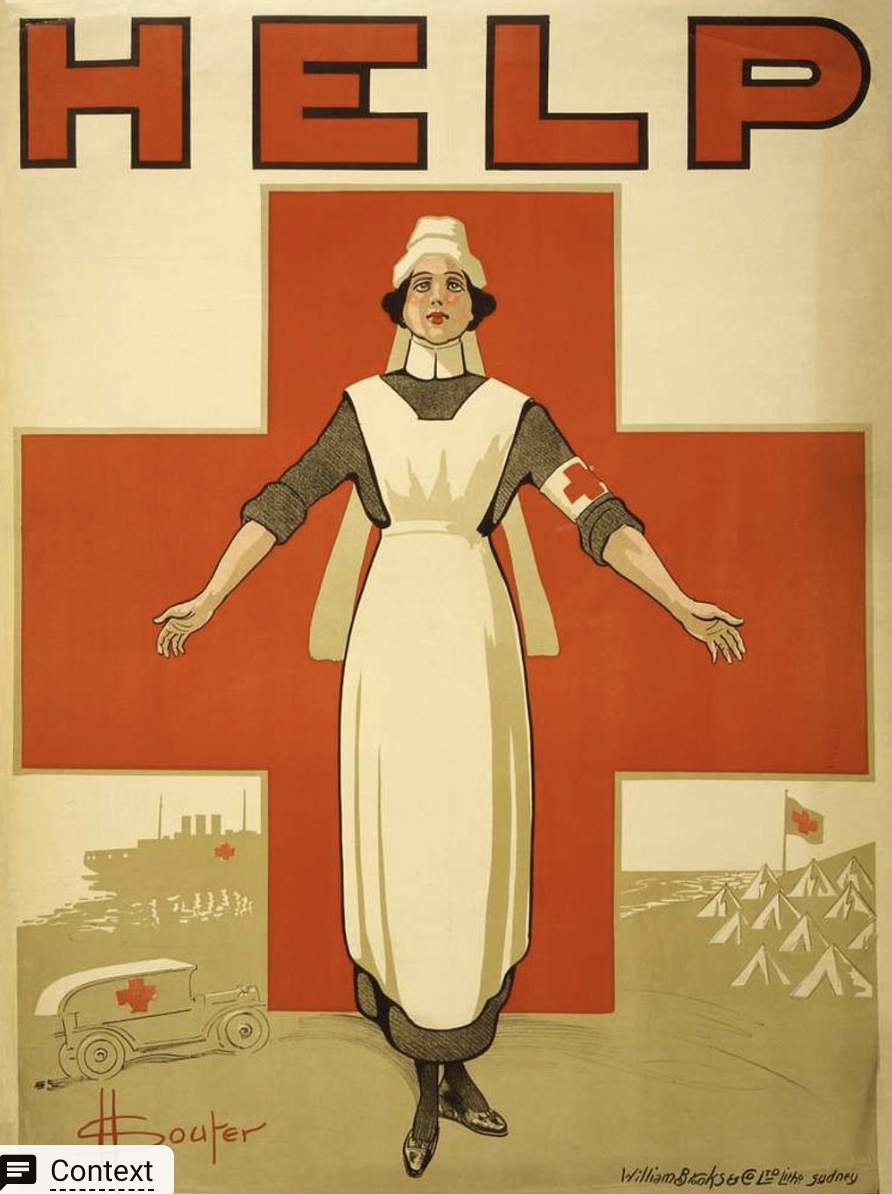
© Wikimedia
And there is a very strong emotional content to his book A Memory of Solferino, which really brought into a new light, if you want, what it is to actually wage war in Europe in the modern age.
That's the fundamental point about the book: it actually says you don't have to be just witnessing or hearing about these atrocities. You can do something about them. And this mobilisation, this activism, is the novel — not entirely new, but still novel — dimension of the Red Cross movement.
And what's fascinating about this is that the Red Cross movement, which starts from almost nothing in the early 1860s, had by 1870 become a sufficiently mobilising force to bring, for the first time, the signatories of the Geneva Convention face to face with one another.
Cold compassion
So is it the first time that we see compassion taking an organised form? Of course, compassion has always existed. It's part of the religious traditions of many, many religions in the world, but it's the organisational shape that it takes that is different. And that implies, of course, new ways of thinking about how you distribute aid, how you distribute compassion.
And for Henri Dunant there's a phrase he uses, which is "cold compassion". And cold compassion means essentially triage. It means that you're going to select people for aid not necessarily on the basis of the severity of their wounds, but based, for example, on their chances of survival or on the logistical capability at your disposal.
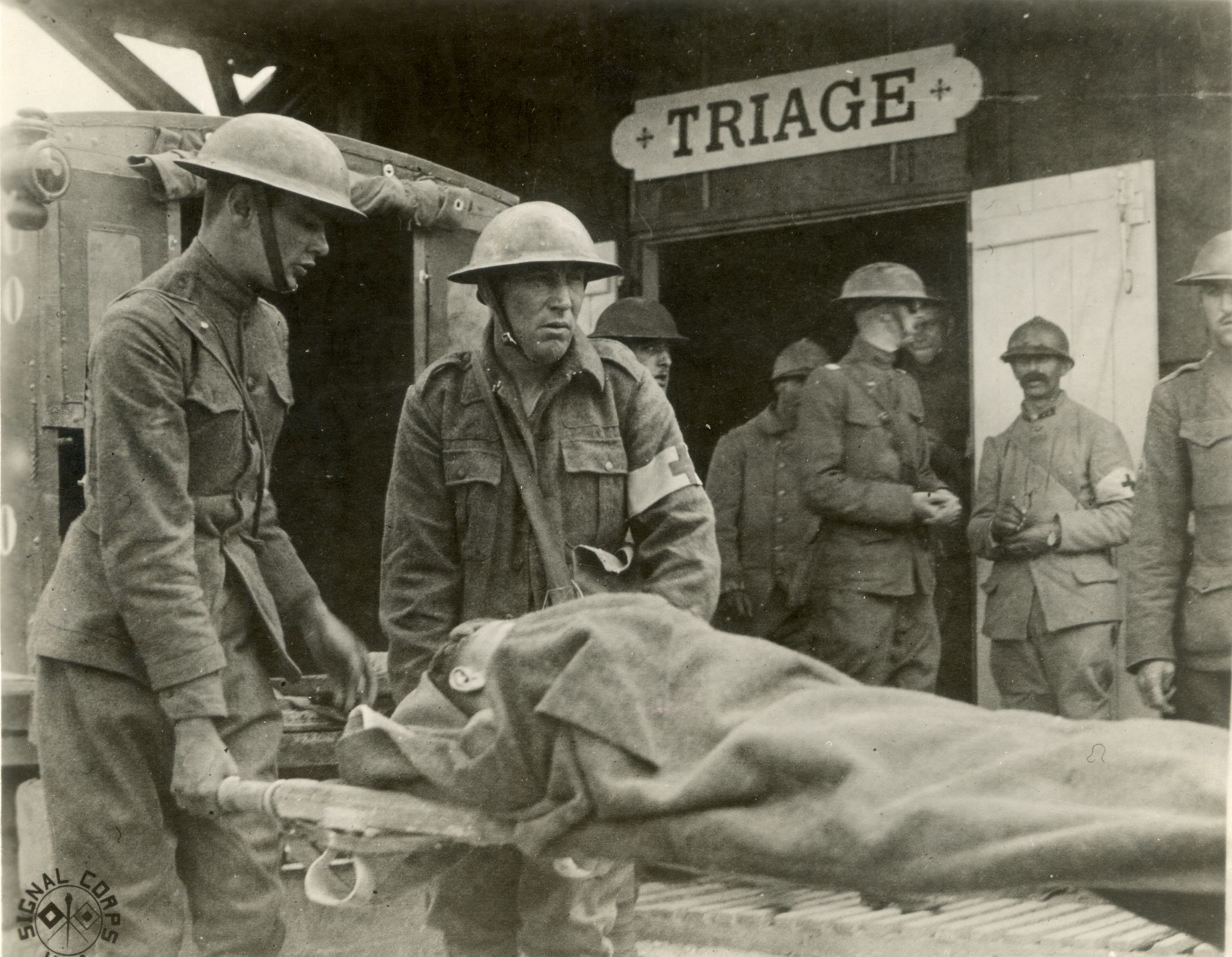
Wounded arriving at triage station, Suippes, France from sanitary train. © National Museum of Health and Medicine via Wikimedia
It's not a new concept in military medicine because triage was used, for example, in the Revolutionary Wars. But it is actually a concept that is democratised and popularised. And I think that makes the Franco-Prussian War and those conflicts of the 1870s a very interesting moment in the history of compassion, or the history of compassion at war.
The wounded soldier
We have a sense that we are entering a new world order where the terms of war are going to become much worse. The range of people who are going to be involved is going to be much greater. Nobody is mentioning the term "total war", but we are very much entering an era of mass mobilisation, and the number of casualties — and long-term casualties — is going to become a new phenomenon.
There's a hierarchy in suffering, in humanitarian response, and even today it's very striking that, in contemporary humanitarianism, the war wounded have a particular status.
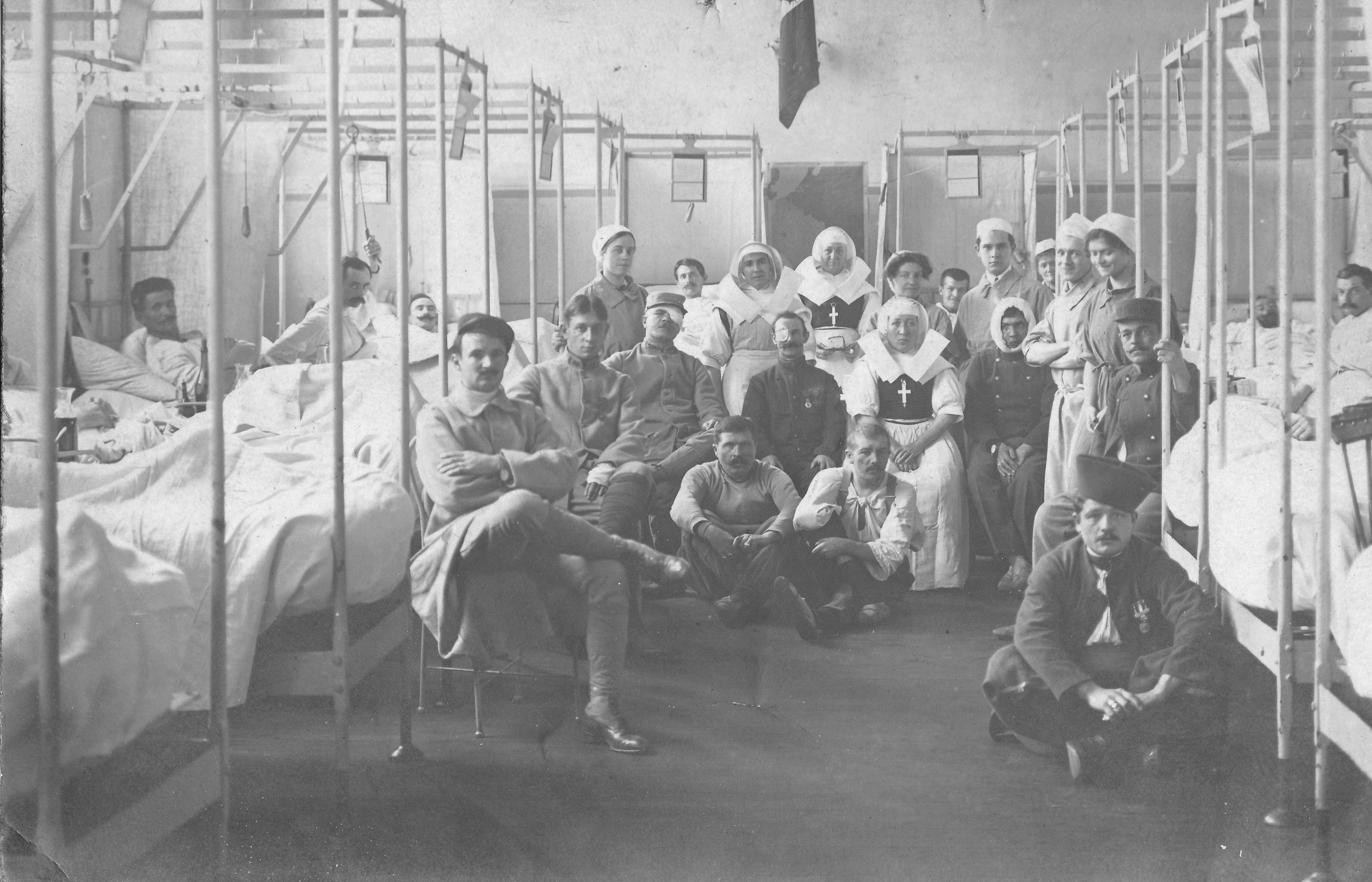
French hospital during WWI. © Wikimedia
In conflicts where women are brought closer to the front, or the bodies of the wounded are taken further away from the front, this interaction between the healing women and the wounded soldier — this play, if you want, on a very Christian iconography, a kind of Pietà iconography — becomes really significant in the popularisation of what humanitarian workers are supposed to do in times of war.
It only reflects a tiny portion of what humanitarians actually do, but it's very significant in the collective unconscious, or the collective representations, of what a compassionate war is.
Industrialized killing
There is obviously a paradox between the growth of industrial warfare on the one hand and care on the other, and you see this paradox very graphically. So I'll give you an example. At the Great Universal Exhibition of Paris, just before the Franco-Prussian War, you see in almost the same image a bunch of guns displayed next to a field hospital, an ambulance.
It represents advanced technical care in times of war. But next to it, you have the brand-new weapons that the Germans have produced, the French have produced.
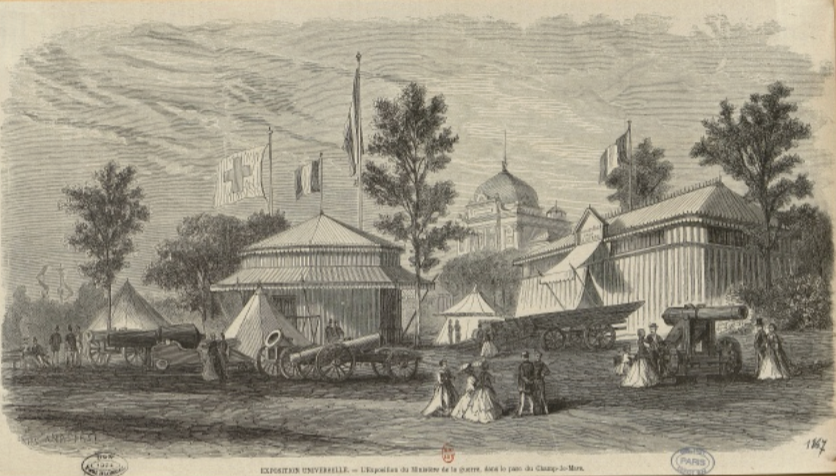
Exposition Universelle, Paris, 1867. © Wikimedia
What motivates many humanitarians in this early period — and even today — is not simply to heal people, but also to observe the effects of modern weaponry on human bodies. So people pay particular attention to high-velocity bullets in 1870, in the same way that today many people are thinking about the types of injuries caused by drones in the Ukrainian conflict.
There is undoubtedly an effort to gather intelligence and information from these modern conflicts.
So it's a complex picture. It's not black and white. There are many nuances of grey and many interconnections between what humanitarians intended to do and what they also delivered in terms of knowledge about modern warfare, which in the end may also serve the development of modern warfare.
The role of humanitarian archives
The role of archives in writing this history has been a contentious subject, actually, because originally, in the 1990s, when I started writing about these topics, a lot of humanitarian archives were closed. They weren't available to historians for reasons of confidentiality, perhaps security, or simply a habit of secrecy.
Things have moved on massively, or had moved on massively, and a lot of humanitarian archives opened to researchers. They are essential on several fronts. On the one hand, they give us a picture of who did what and how organisations tried to set up responses — this "cold compassion": how was it deployed? What kinds of resources were brought into play? What kinds of political alliances were made to enable people to go and help the wounded and the sick in times of war?
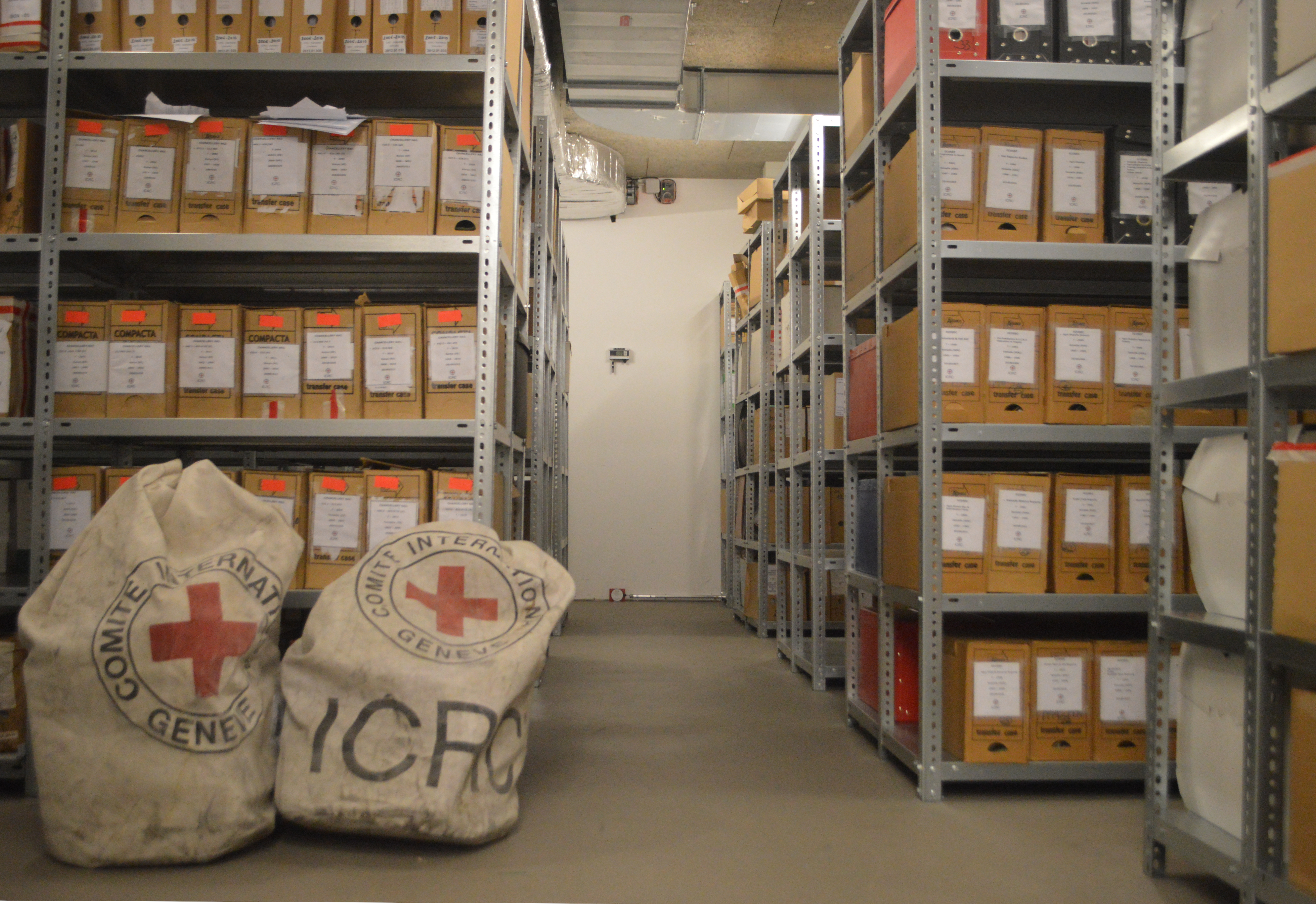
Archives of the International Committee of the Red Cross (ICRC). © Wikimedia
But they also reveal the breadth of causes that humanitarian actors started to embrace alongside warfare. Very interestingly, this includes the use of warlike language: war against this or that, campaign against this or that, battle against tuberculosis, battle against poverty. All this militarised language became a significant part of the broader social remit of humanitarian action in that period.
All of that is best found in the archives, because humanitarian actors are fundamentally acting at a symbolic level, in the sense that most aid will not actually be delivered by humanitarian actors, but by military services or by people who are nearby.
We therefore have to relativise how little — or how much — humanitarian actors matter in times of war. We also have to understand how they align with national priorities, military priorities, and how they fundamentally become part of a much broader conversation about the nature of violence in the modern age.
Neutrality and humanitarian work
There is an interesting issue that emerges in conclusion in relation to neutrality and humanitarian work. On the one hand, very early on, humanitarians are asking for hospitals to be excluded from the war zone and for carers also to be treated as neutral. This debate on neutrality ebbs and flows throughout the 20th century.
What is a hospital? What is an ambulance? What is a carer? Is it enough to carry somebody's body to become a carer? Do you have to carry an emblem? Do you have to wear an armband?
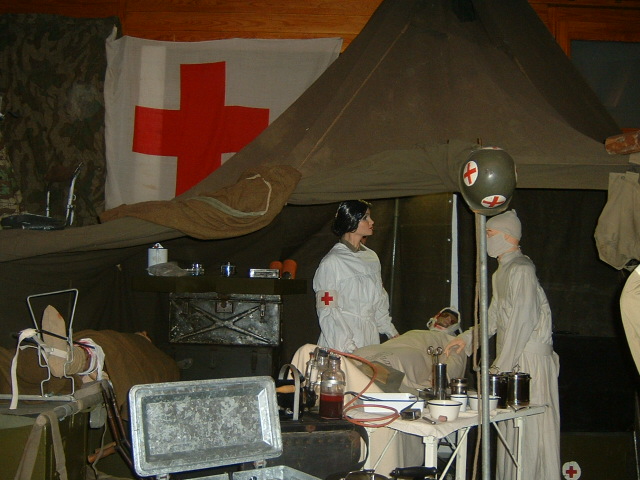
Mannequins at the National Museum of Military History in Diekirch, Luxembourg. © Wikimedia
There are a multitude of debates about whether flying a Red Cross flag is enough to protect you or not; whether, if someone shoots from a hospital, that hospital turns into something other than a hospital. In other words, can violence be applied to a hospital? Does it have to be proportionate violence?
These are debates that are still with us today.
Fundamentally, humanitarians are in a peculiar situation in relation to the military because the military have to give access. They have to guarantee access. They have to allow some degree of freedom for the practice of medicine, for example on the battlefield. That access is negotiated. It is always contested.
And we do not see many instances of pure neutrality.
Yet in 1965, when the Red Cross movement gathered in Vienna, they formally articulated the fundamental principles of the Red Cross and Red Crescent movement. Among those principles are humanity, neutrality, impartiality, and independence.
These four principles would then be adopted in 2001 by the United Nations General Assembly as the fundamental principles of humanitarianism.
A political undertaking
If I had one misconception to fight back against in relation to humanitarian aid, it is, of course, the idea that it is a naïve undertaking. It is a very political undertaking. The organisations involved in the deployment of aid then, as now, are extremely savvy. They are fundamentally intervening in a literal minefield of complexity.
Yet their message is simple, and the iconography is simple. The relationship, if you want, to emotions — which is so significant in compassion — is absolutely dominant.
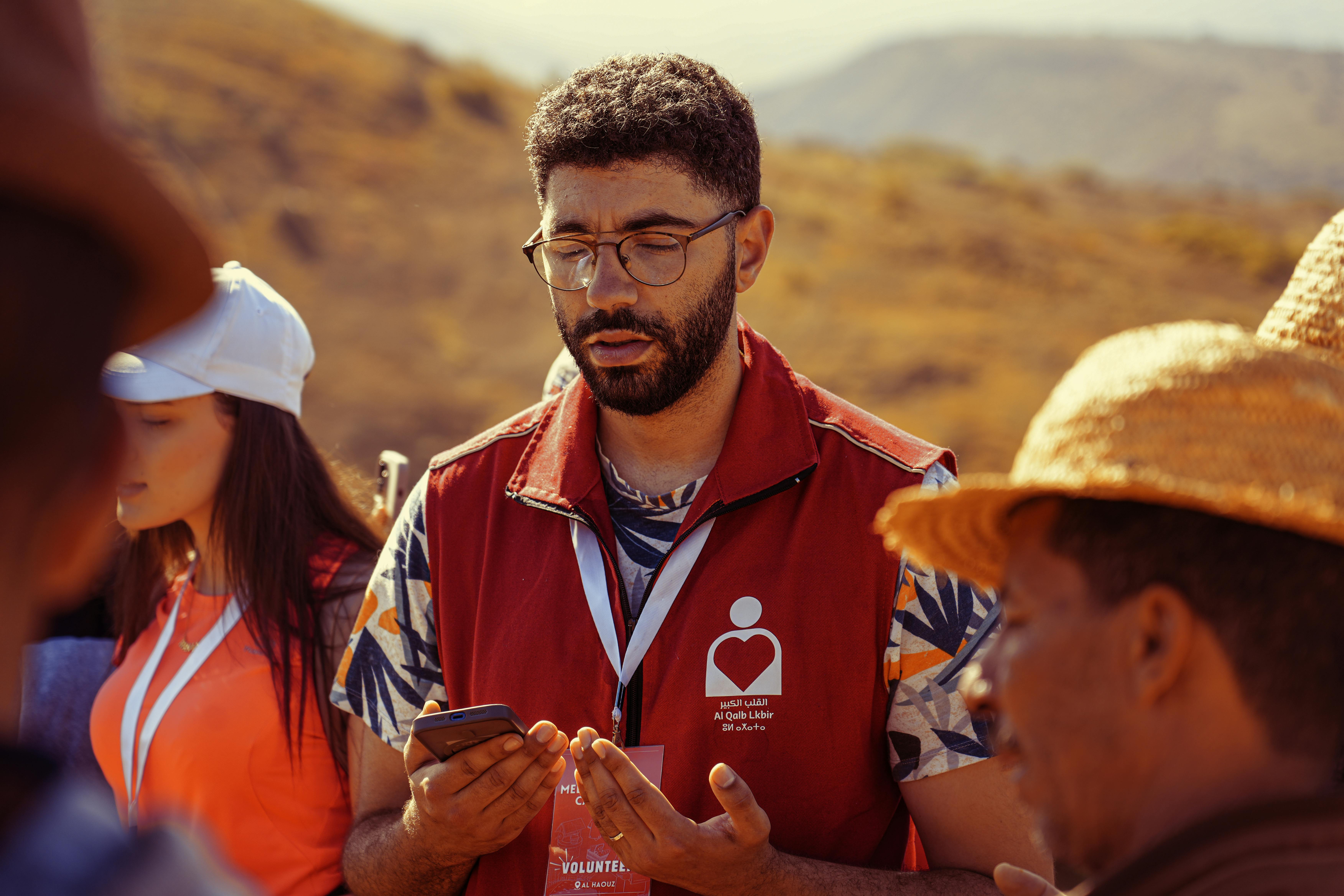
© Mohammed Amine Jaddari - Pexels
Now there is a paradox, if you want, between the practices, which are incredibly complex and where you need to see all the negotiations that take place — and the archives help us to understand those negotiations — and the representations, which are often more simplistic, or which tend to be more abstract, perhaps more religious, more emotional.
The misconception is to believe the propaganda.
So we need to be careful not necessarily to believe what humanitarians think they do, and instead look more closely at what they actually do.
Editor’s note: This article has been faithfully transcribed from the original interview filmed with the author, and carefully edited and proofread. Edit date: 2026
Discover more about
War and compassion
Taithe, B, Weissman, F & Le Paih, M, (2022), Historicising Humanitarian Action: Synchronicity in Historical Research and Archiving Humanitarian Missions. Journal of Humanitarian Affairs, 4, 2, p. 49-56.
Taithe, B, (2015), The "Making" of the Origins of Humanitarianism?. Contemporanea (Bologna), 18, 3, p. 489-496.
Gill, R, Barber, C, Dampier, H & Taithe, B (eds), (2025), Humanitarian Handicraft: History, materiality and trade, c. 1840-1980. Manchester University Press.
Farré, S, Fayet, J-F & Taithe, B, (2022), L'Humanitaire s'exhibe (1867-2016): The Humanitarian Exhibition (1867-2016). Georg éditeur.
Fiori, J, Espada, F, Rigon, A, Taithe, B & Zakaria, R (eds), (2021), Amidst the Debris: Humanitarianism and the End of Liberal Order. Hurst Publishers.
Taithe, B, (2001), Citizenship and Wars: France in Turmoil 1870-1871. Routledge.
Taithe, B & Thornton, T, (1998), War: Identities in Conflict. Sutton Publishing Ltd.
Continue exploring



Explore this knowledge network
Continue exploring...
0:00 / 0:00