Here the important distinction is that words that refer to objects and actions, concrete words indeed refer to things in the world that we can see, we can touch, we can act upon. Whereas instead, the words like curiosity, like anger, refer to things that are not out there in the world. The fact that abstract words and concepts cannot be seen or touched or acted upon makes them harder to learn. Think that children, for example, at age four, know about nearly 1000 words, and of these words, only 10% are abstract. The rest are all referring to concrete things. By the age of ten, instead, their vocabulary is more balanced between abstract and concrete words, with abstract words being nearly 50% of the words they know. So they start slow, abstract words, but then they are learned. And the point is, why first of all, are they harder to learn? And secondly, what helps children learning them?
Learning language
Professor of the Psychology of Language
Language acquisition shows immense individual variation, beginning with concrete words rooted in experience before expanding into abstract concepts through emotion and social interaction. Unlike artificial intelligence, children learn language through a uniquely embodied and socially grounded process.
- Language acquisition milestones exhibit massive individual variability, though children universally begin with concrete words deeply tied to their immediate daily experience.
- Concrete words refer to observable objects and actions, whereas abstract words describe unseen states of mind or feelings, making up only 10% of a child's vocabulary at age four.
- Early abstract learning is uniquely grounded through the affective system, as caregivers express emotional connotations through facial expressions and bodily interactions.
- Children with developmental language disorders or on the autism spectrum experience holistic language impairments across all semantic domains rather than a selective deficit in abstract words.
- Unlike Large Language Models that require massive datasets spanning lifetimes of data, children learn language through an experiential, socially embedded process requiring orders of magnitude less data.
Our first words
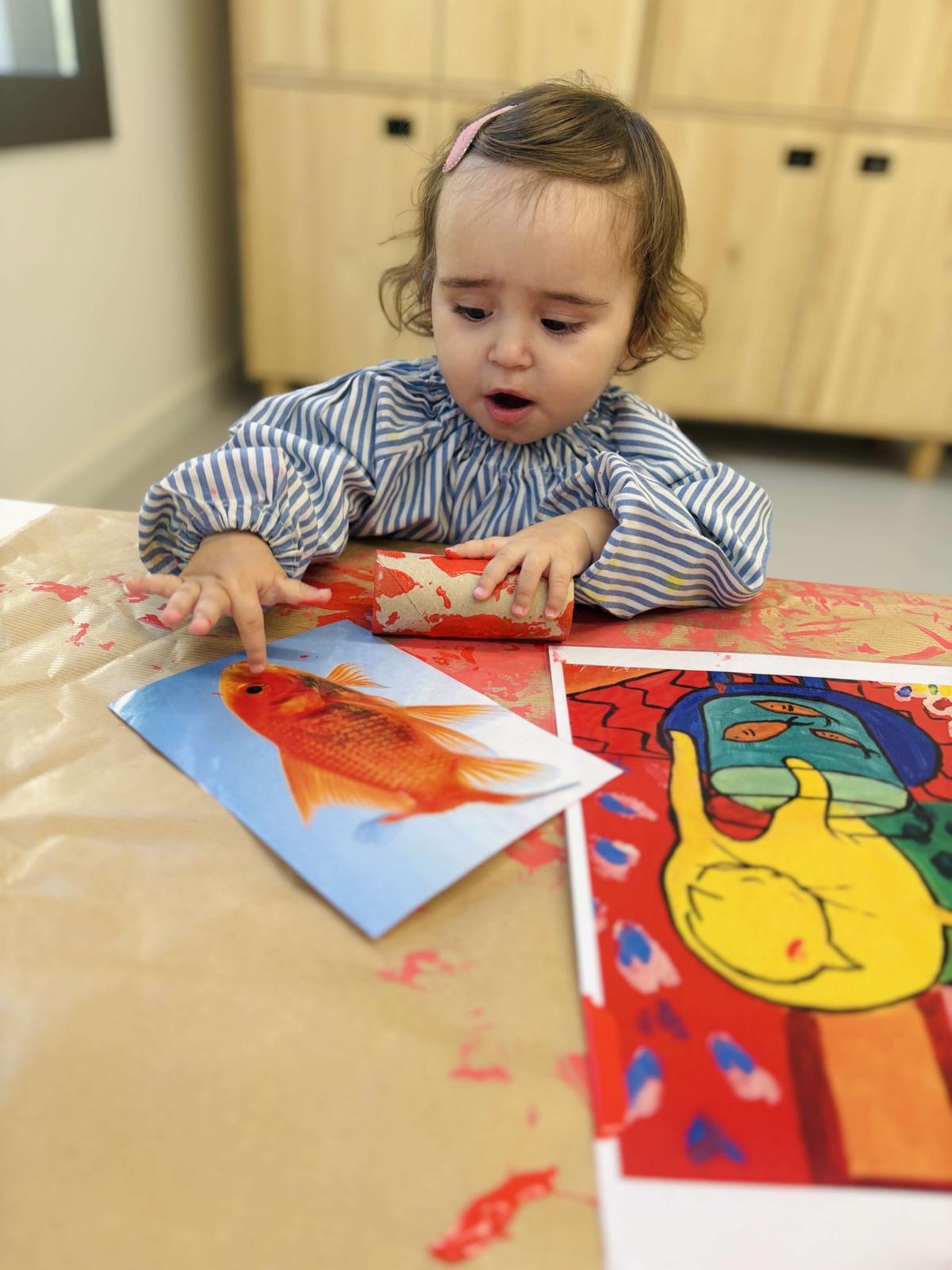
One fundamental thing about language acquisition is that the variability in terms of meeting milestones that we observe among children is huge. So some children will have their first words before they turn one year old. Some children will not until they are nearly two. The variability is huge, but in general, what we see is that their initial repertoire of words is related to their daily experience and they are concrete, so it will involve baby, it will involve kitty, it will involve mom and dad. It will involve nappy and bottle because these are the things that, certainly in our Western cultures, are typical of the daily experience of children. These are all concrete things. And it's only a bit later on that children begin to grasp the meaning of some abstract words.
© Personal collection
Why some words are easier
Not all words are equally easy or difficult to say, to understand, and to learn. So, for example, a word like apple is a lot easier than a word like freedom. There are many reasons why that's the case. So starting with the fact that apple is shorter than freedom. That's important, as is the fact that apple is a word that is used in the language more than a word like freedom. So the frequency of use of the words also matters to make them easier or more difficult to learn. The frequency is associated with when words have been learned during development. So apple has been learned before freedom. That also makes it easier to learn. But words also differ in what they mean, of course. And also these differences in meaning matter. In fact, some meanings may be easier to retrieve, to produce, and to learn than other meanings. So in this respect also, the meaning of apple, even intuitively, it's easier than the meaning of freedom.

© Shutterstock
Concrete and abstract words
The meaning of words can make them easier or harder to use and to learn. And one important distinction when it comes to meaning in this respect is indeed whether the word is a so-called concrete word referring to objects like caterpillar, like apple, or actions like jumping or meandering, or colors like red, green, and so forth on the one hand, or abstract: referring to feelings that the person has, like sadness, anger, or fear, or referring to states of mind, like curiosity. And this makes words easier and harder.

© Shutterstock
Emotions and interactions
There is one interesting fact that distinguishes concrete and abstract words. That is, abstract words tend to have emotional connotations a lot more often than concrete words. Now why would this matter? Well, one idea is that this can help children at the very beginning to start learning abstract words. And this would happen because these more emotion-laden words, which are abstract, would be produced by caregivers in interaction with children, while the caregiver is expressing the emotion in their face and in their actions at the same time. So there would be a bodily way to ground the meaning of these initial abstract words that is not through the senses, but is through the affective system.

© Shutterstock
Of course, not all abstract words are emotional, and just to know whether a word is positive or negative is not really enough. It doesn't give us the meaning of the word itself. There must be more. And as the child begins to be a little older and starting to go to primary school, that is the time in which we really see abstract words becoming more common in the children's vocabulary. The children have developed their cognitive repertoire a lot more. They can abstract categories from just looking at single instances. They have the capacity to reflect on their mental functioning, and moreover, they of course have acquired language to an extent that they are very active as an interlocutor in their exchanges and therefore, in social interaction, can ask for clarification, can negotiate with teachers and caregivers the meaning of these words in such a way that they can learn them. And that's when we see that these words become, in fact, more common in the language.
Language disorders
There are cases in which language is not on track, and there are in particular two cases where this happens. One is the case of developmental language disorders. That is, it can be described as a persistent problem in language learning and in language use that has an important impact on the child's ability to learn content in school and also to have a social life themselves. Developmental language disorders are usually diagnosed when there are no other possible reasons for the delay. So it's not due to hearing problems. It's not due to motor problems, it is not due to intellectual disability or to autism, and it can involve any aspect of language more or less.

© Shutterstock
Some children may have more problems with learning words. Some children may have more problems with putting words together in a syntactic structure. Some people may have more problems with dealing with the pragmatic aspects of language and interaction, namely those aspects related to the meaning and related to the flow of the conversation, or they can have all of these problems together. This is one case. The other case is children who are on the autism spectrum. The autism spectrum is characterized as a very complex problem that can be associated with language impairment. In addition to the language impairments, children on the autism spectrum tend to have perceptual sensitivities, being, for example, very sensitive to light or to specific noises, patterns of repetitive behaviors, and social and emotional problems. Now, intuitively, one may think that for both children on the autistic spectrum, as well as children with developmental language disorders, learning words that are abstract may be more difficult than learning words that are concrete. However, this does not seem to be the case. Children on the autistic spectrum, as well as children with developmental language disorders, if they have a language impairment, are impaired in learning words across semantic domains.
Language acquisition and artificial intelligence
There is a lot of interest at the moment with respect to how AI learns language and how AI models, in particular large language models like GPT or ChatGPT, which is the conversational version of the GPT models, are performing language tasks, and there's evidence showing that they can perform in a way that is quite similar to humans in linguistic tasks. But does it mean that they learn language just like a human child? And the answer is no, certainly not at this point.

© Shutterstock
First of all, there is a data gap. In order to perform at the same level in a similar way as humans do, these models need to be trained on data, on amounts of language, that are orders of magnitude way bigger than the amount of language that children are exposed to when they learn language. In fact, the amount of language that these artificial intelligence models like GPT need is orders of magnitude larger than the amount of language that a person is exposed to during the course of their life. So clearly, children are doing something different. They move around. They see things. They touch things, they experience things, and they learn words, for example, in these very experiential ways. A model cannot do that. Children are also embedded in a social context when they learn language. They learn language in interaction with their caregivers. Their caregiver is responding to their actions and providing the information they need. Clearly, this is something that is not there in any language model.
Editor’s note: This article has been faithfully transcribed from the original interview filmed with the author, and carefully edited and proofread. Edit date: 2026
Discover more about
Learning language
Ponari, M, Norbury, C F & Vigliocco, G, (2017). Acquisition of abstract concepts is influenced by emotion. Developmental Science.
Vigliocco, G, dellaRosa, P, Vinson, D P, Devlin, J, Kousta, S-T & Cappa, S F, (2013). The neural representation of abstract words: The role of emotion. Cerebral Cortex, 24, 1767-1777.