


To understand how much of a breakthrough the discovery of the first planet has been, we have to go back in time. We have to go back to a time when there were no known planets orbiting other stars. This means going back to the 1990s. At that time, people had a fairly good idea of the formation mechanism that would lead to a solar system.
The discovery of a new planet
Science is always grounded in data. Theories evolve, but data remain. Science is driven by an ongoing effort to make sense of the universe based on what we observe.
Professor of Physics
07 Apr 2026
Citation-ready summary
Science is always grounded in data. Theories evolve, but data remain. Science is driven by an ongoing effort to make sense of the universe based on what we observe.
Author: Didier Queloz
Last updated: 07 Apr 2026
Key Points
- The discovery of 51 Pegasi b overturned established ideas about planetary systems.
- It showed that planetary systems can be very different from our own. Many planets are much closer to their stars, and there is an enormous diversity of planetary types
- When the facts tell a different story, and you are confident in those facts, then you must revise your understanding of the universe.
- What it means to be a good scientist is this underlying belief that things make sense, and that if you work hard enough, you can understand what they mean.
Searching for the invisible
We had a model to understand the formation of the solar system, with small rocky planets near the star and big giant planets full of gas further away, essentially the same kind of gas you have in the Sun.
Astronomers were very eager to detect other planets, with the idea that they would look in a similar way to the solar system.
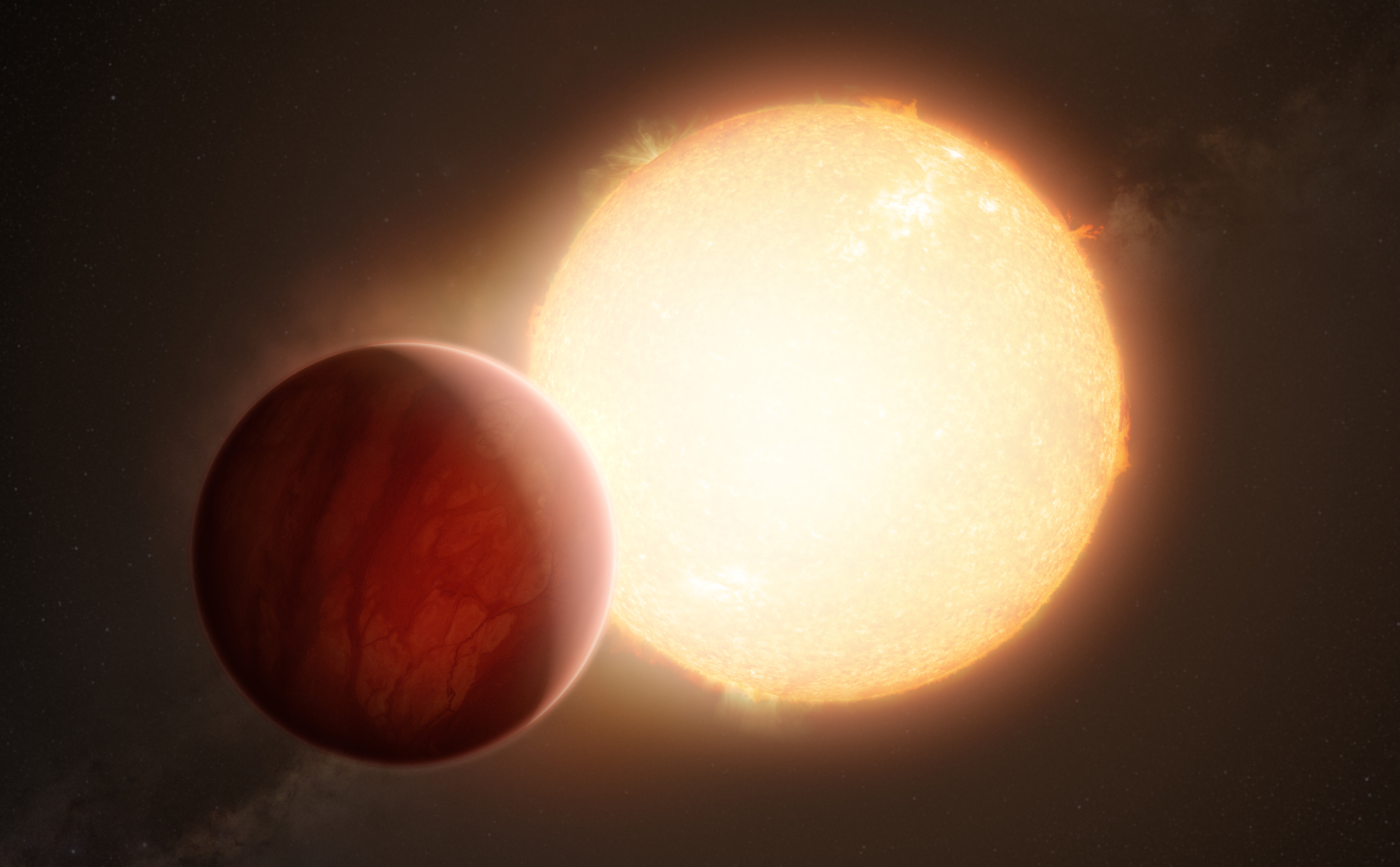
An artist's impression of a hot Jupiter orbiting close to its star, © Wikipedia
The challenge is how to detect a planet. A star is easy, but a planet is challenging. Not because it is small, but because it is next to something very bright and very big. If you look at the solar system from the side, the light that comes from the Sun is enormous. In the infrared, which is the best way to detect a planet, the Sun is one million times brighter. In visible light, the one we see with our eyes, it is one billion times brighter. It is huge.
We have no direct way to see planets. We rely on indirect techniques, where we look at the star and search for evidence of a planet. One of these techniques is called radial velocity, where you observe changes in the speed of the star that would be related to an orbiting planet that pushes and pulls the star in its orbit.
A planet that was impossible to detect
Michel Mayor was working on radial velocity programmes, not for planets but for studying binary stars and galactic evolution. He had the opportunity to build a better instrument in collaboration with the Observatoire de Haute-Provence, which also wanted a spectrograph — the machine used to measure spectra and compute stellar speeds.
They embarked on developing a new instrument that would be better than what Michel had in the 1970s. That is how I came in. At that moment, there was no idea of finding planets. The machine was not designed to reach extreme precision. We wanted more accuracy, but not at the level required for detecting planets.
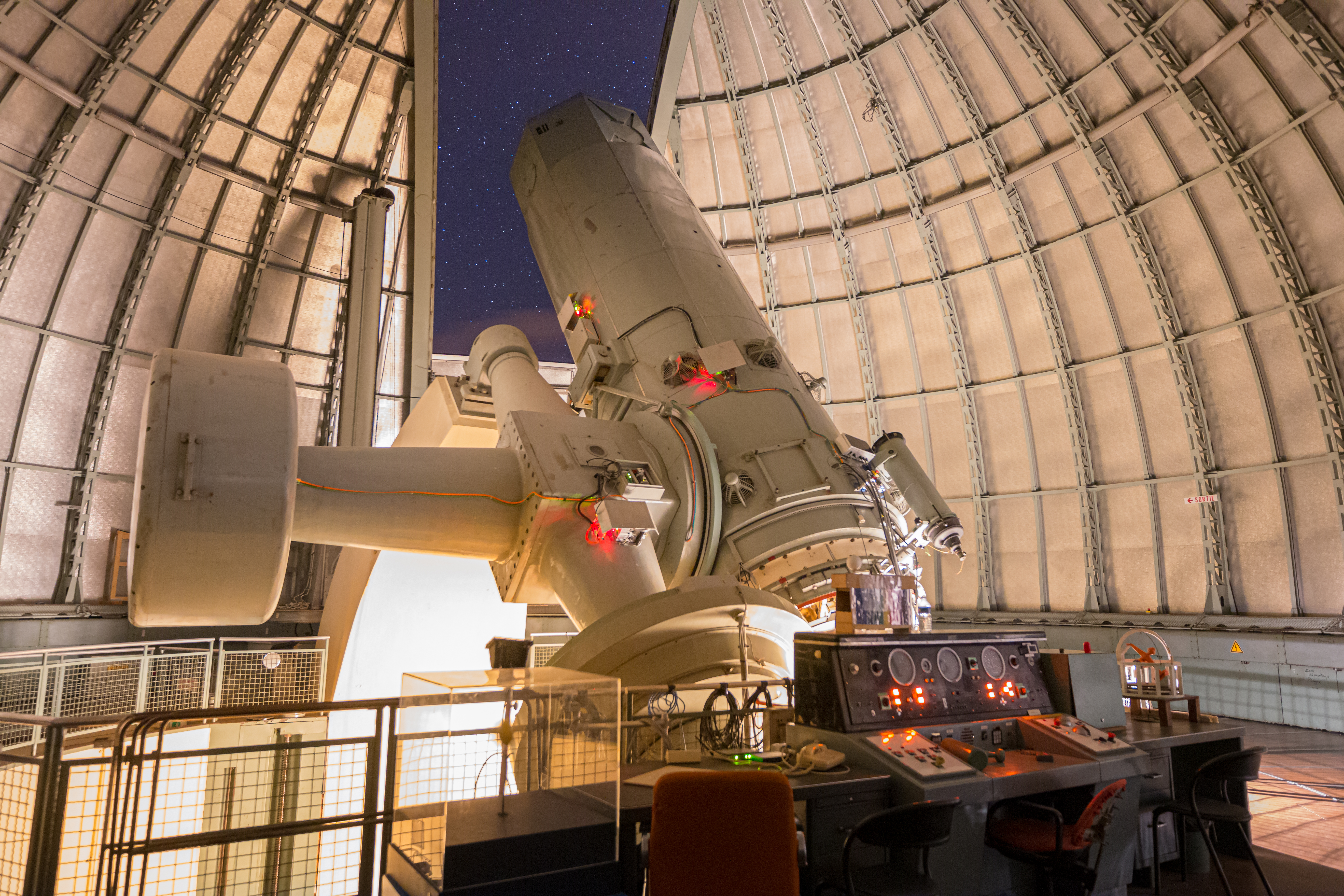
The 193-cm telescope at the Haute-Provence Observatory, © Wikipedia
Starting my PhD was exciting. I was working on a new instrument and fully engaged in pushing it to the best possible accuracy. Eventually, I succeeded in achieving something much better than what Michel had in mind. It took longer — he thought it would take six months, and it took me three years — but in the end we had a much better machine.
What was critical is that we realised the machine had a precision of about ten metres per second. For us, that value was very meaningful, because it corresponds to the effect of Jupiter on the Sun.
At that point, we understood that the instrument we had built, called ELODIE, could detect objects as small as planets. However, everyone had the solar system in mind, so it was assumed that detection would take years. When the programme started in 1994, it was obvious to all of us, including Michel and myself, that I would never detect a planet.
51 Pegasi
The story did not unfold as expected. While I was alone at the telescope, one of the stars I observed was 51 Pegasi. We had about 140 stars, and this was one of the brighter ones.
What I saw at the telescope was very strange — and “strange” is an understatement. It was a moment close to panic. The speed of the star kept changing, whereas it should have remained constant. In the galaxy, stars do not change speed unless something is orbiting very close to them. This star was not supposed to have a companion.
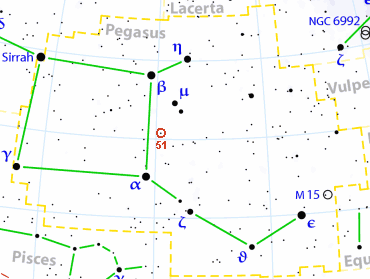
The red circle indicates the position of 51 Pegasi, © Wikipedia
I kept measuring and initially thought something was wrong with the instrument or my code. It was a new programme with many lines of Fortran code and a brand-new instrument. The probability of a mistake was high, and I worked intensely to understand what was happening.
After a couple of months of work, mostly on my own because I was hesitant to raise it with Michel, I realised there were no mistakes. I started to look for patterns, and eventually I found a periodic signal. This took time because access to the telescope was intermittent.
From 1994 to March 1995, I gradually built an understanding of the data. When I finally derived an orbit, I was very surprised. The period was about four and a half days, a bit less than four and a half days, but the corresponding mass you would compute from the amplitude would be less than the mass of Jupiter.
The data were right
I realised I had found a planet completely unlike anything in the solar system. Jupiter takes more than ten years to orbit the Sun.
I sent the data to Michel, and we worked together on it. He remained very sceptical. As any good scientists would do, we made predictions — an ephemeris — of what the star’s velocity should be.
When the star 51 Pegasi came back, we were at the telescope together this time with my data, my spreadsheets. And every night was like a game. You have the prediction and you measure the speed and you say, oh my God, this much. So you do that for the first night. You say, okay, it's luck. You repeat the second night, you say, well, it's still luck. The third night I say, well, it becomes more than luck, but we have to be very careful. We waited the fourth night of observation where the prediction was matching the data to say, okay, that must be real.
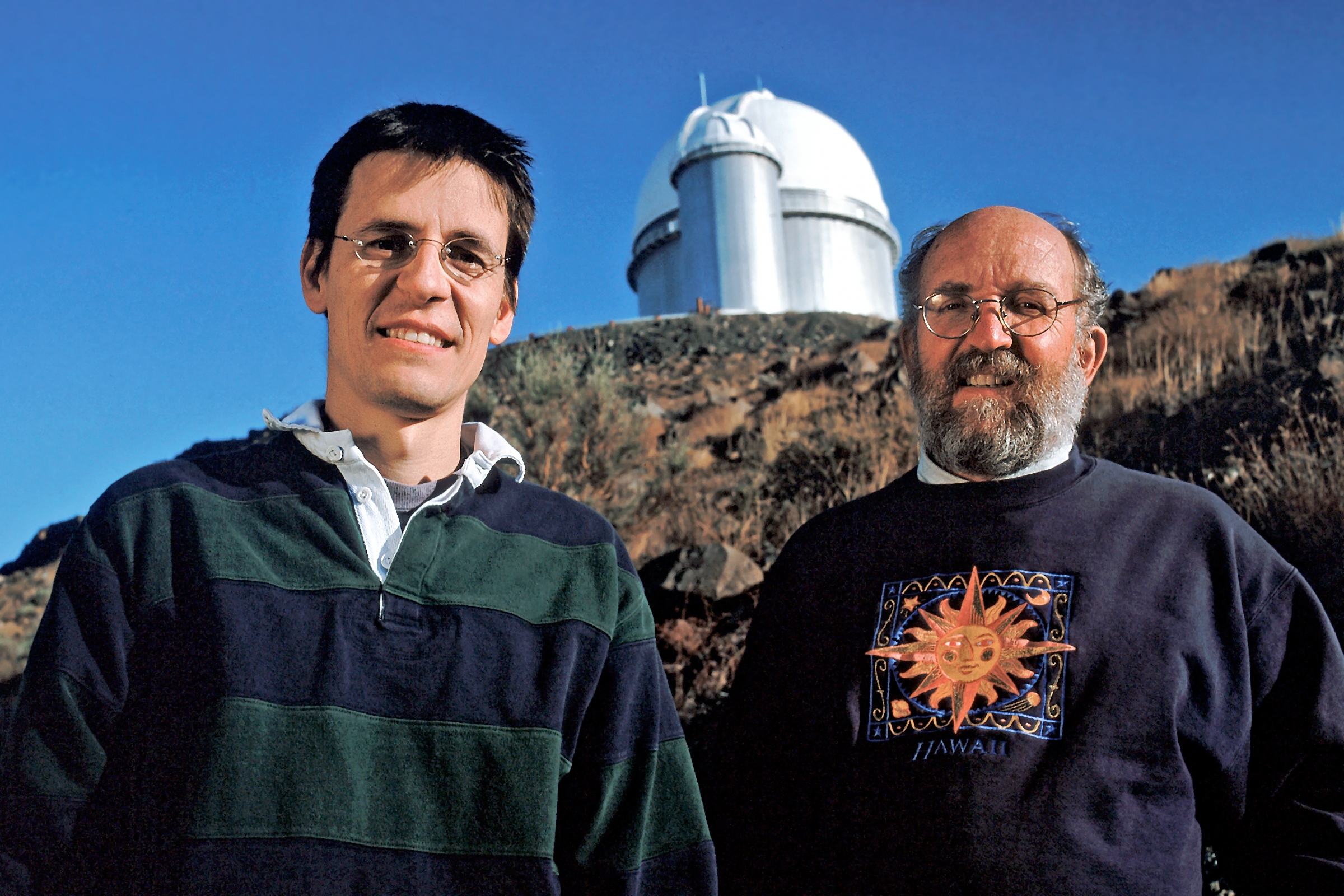
Didier Queloz and Michel Mayor at La Silla, © Wikipedia
And at that time, we realized we had a big problem because we had the confirmation that the data were right. But then, in front of us, we had the community.
“A minefield”
We were entering a field where many false detections had been claimed before. It was a minefield. And then the worst of it, we were detecting a planet that nobody was expecting. Moreover, we were presenting a planet that theory could not explain.
It was a multiple challenge. At the time, I did not realise how difficult it would be. The years following the discovery were a very ugly moment for me. We were pushing a story that very few people would believe, because it was so transformational. It was so new, so different from what everybody would expect. It was too much ahead of its time.
It took four years — until when the first transit was observed — for these planets to be fully accepted. One of these hot Jupiters had the right angle Hd 209458 to produce a transit. From 1995 to 1999 we had maybe a dozen of planets detected by us and our American colleagues. And then, by 1999, it became obvious that they were real
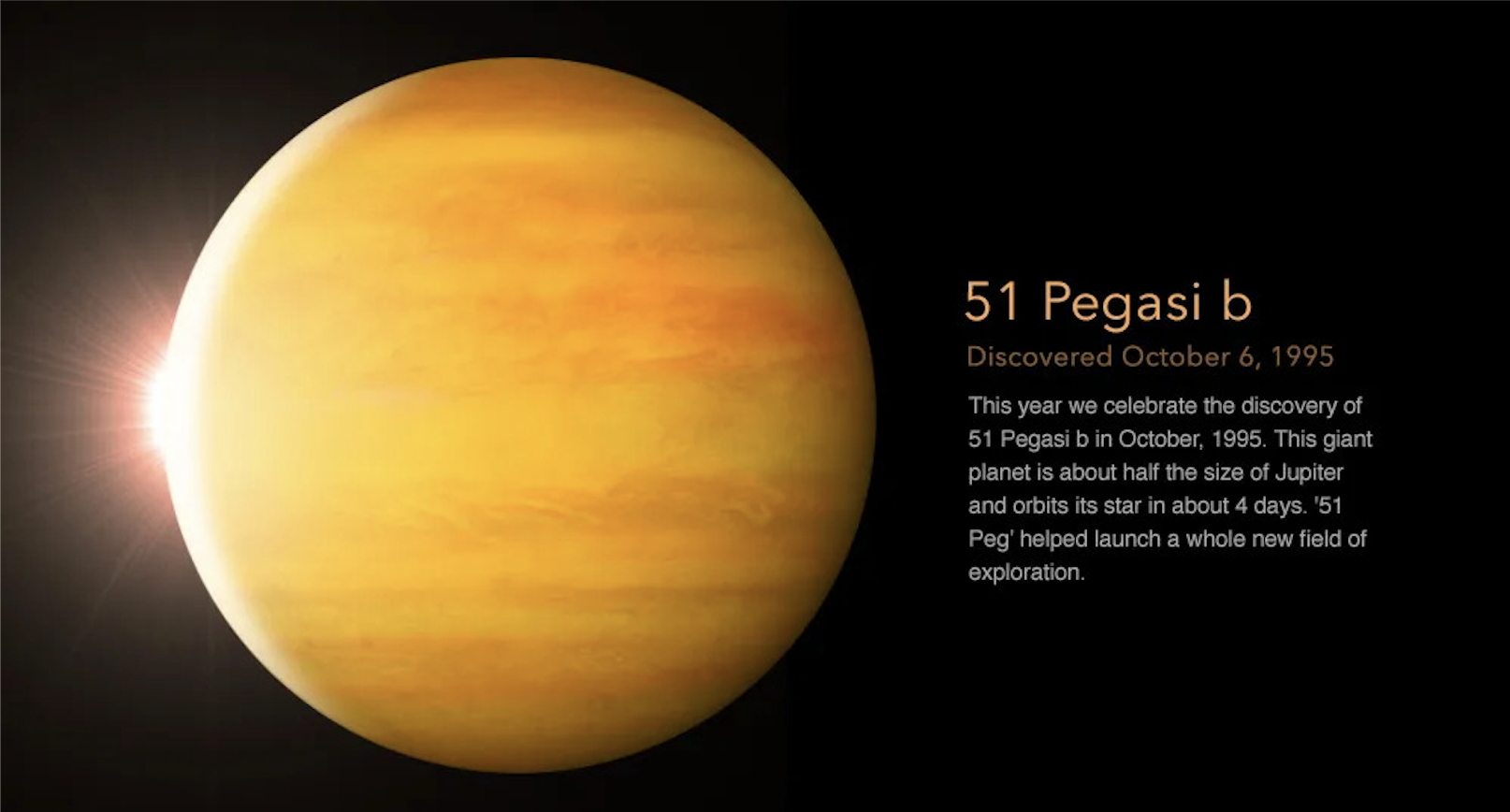
51 Pegasi b, © Wikipedia
This discovery changed the field profoundly. It showed that planetary systems can be very different from our own. And then the field kept expanding the same way. We detected planets nobody was expecting. We know today that the vast majority of the planetary systems are much closer to their star that we are in the solar system. They would fit within the orbit of Mercury in our solar system. And there is an enormous diversity of planetary types, mini-neptune, super-Earth, that just show the diversity of structures.
Science is about facts
Scientific discovery is a big topic. I think the story we went through is very rare. Science is rarely done like that. Most scientific advances — and I think it is better this way — are made through small steps. In a sense, you improve things incrementally, you adjust a little, and knowledge evolves gradually. It is more a sequence of small changes than a sudden shift. It is very rare to experience what we might call a “crisis”, where the baseline of a field is fundamentally changed.
This has happened in the past. Physics had its “high days” in previous centuries, when brand new physics emerged — quantum mechanics, relativity — opening completely new fields of discovery. But most of the time, you know what to do and you know what to expect. What we experienced was something unexpected.
So how do you deal with that in science? Because science is not about theory — it is about facts. And when the facts tell a different story, and you are confident in those facts, then you must revise your understanding of the universe. That is exactly what happened to us. We had an idea of what a planet should be like, but that idea was too rigid. When we started to look at the data, we realised that reality was far more complex than we had imagined.

Shutterstock
As a result, the entire theory — the whole concept of planetary systems — had to be reconsidered. And whatever field you are working in, you always come back to the data, because that is the only thing that endures over time. There is no theory that has not changed. Even the best ones — take Newton — are still in use, but they have been revised many times because they are not universally applicable. At very small scales, you need quantum mechanics; at high masses and velocities, you need general relativity. Any theory is, to some extent, wrong — it reflects the data you have been using at the time to build the theory.
And this is all about that. Science is data driven and trying to make sense of the universe on the basis of the data you can collect.
The curiosity disease
Quite often, I get asked what it means to be a good scientist. The only way I can answer is by looking at myself and trying to understand who I am and the kind of work I do. There are certainly elements in my life, in my own psychology, that I think explain why I became a professional scientist. One key element is a level of curiosity beyond the average. I would even say it is not normal — I sometimes describe it as a kind of soft disease. You are deeply curious. You want to understand everything. And when I say everything, I really mean everything — there are no boundaries. I am as interested in social psychology as I am in physics.
There is this idea that things make sense, and that if you work hard enough, you can understand what they mean. That is something very profound for me. I do not know why, but it is simply who I am. When I wake up in the morning, I feel that my day will be fantastic because I will learn something. The day is about triggering my curiosity, and there is something almost magical in that.

© Shutterstock
My body is getting older, but in my mind I feel I am in exactly the same state as when I was a teenager. I have more knowledge now, and perhaps my brain is a bit more worn than it was when I was younger, but the energy to understand remains. And that, I think, is something very deep. I sometimes compare it to an artist or a writer, for whom creating is a matter of life and death. That is why, for a scientist, there is one word that is almost taboo: retirement. I do not think we can retire. It is impossible.
Editor’s note: The original filmed interview has been edited for length and approved by the author. This article has been faithfully transcribed from the original interview filmed with the author, lightly edited and and carefullyproofread. Edit date: 2026
Discover more about
51 Pegasi
Mayor, M., Queloz, D. (1995), A Jupiter-mass companion to a solar-type star . Nature 378, 355–359.
Baranne, A., Queloz, D. et al. (1996), ELODIE: A spectrograph for accurate radial velocity measurements . Volume 119 / No 2 (October II 1996) Astron. Astrophys. Suppl. Ser., 119 2 (1996) 373-390 p>
Queloz, D. (2019), Nobel Prize Lecture
Continue exploring





Explore this knowledge network
Continue exploring...
0:00 / 0:00