


By humanitarian law, we primarily mean restraints on war: the Geneva Conventions, the Hague Conventions, and codes of behaviour that draw from a tradition known as le droit des gens — the law of nations — a legal tradition asserting that there are acts which should never be committed in war: rape, pillage, and other crimes regardless of circumstance.
Modern humanitarianism
The humanitarian archive emergency symbolizes the fragile struggle to preserve evidence, memory, and humanity in times of violence and humanitarian crisis. This conversation opens urgent discussions about reassessing humanitarian law, addressing war crimes, and reaffirming the need for accountability for all those involved.
Professor of Cultural History
14 Jun 2026
Citation-ready summary
The humanitarian archive emergency symbolizes the fragile struggle to preserve evidence, memory, and humanity in times of violence and humanitarian crisis. This conversation opens urgent discussions about reassessing humanitarian law, addressing war crimes, and reaffirming the need for accountability for all those involved.
Author: Bertrand Taithe
Last updated: 14 Jun 2026
Key Points
- Modern humanitarian law emerged to place restraints on war through the Geneva Conventions, the Hague Conventions, and international legal frameworks designed to limit suffering.
- Contemporary conflicts increasingly challenge humanitarian law, as attacks on hospitals, healthcare workers, and civilians blur the boundaries between military and humanitarian spaces.
- Humanitarian actors not only provide aid but also collect evidence, preserve records, and document violence that may later shape historical understanding and legal accountability.
- Humanitarian archives are fragile and increasingly threatened by war, political erasure, digital loss, and funding cuts — yet without them, vulnerable communities and their suffering risk disappearing from history.
Humanitarian laws
What made modern humanitarianism different from previous generations of aid in times of war is undoubtedly that, from the mid-19th century onwards — but especially in the second half of the 20th century — there is a renewed emphasis on humanitarian law.
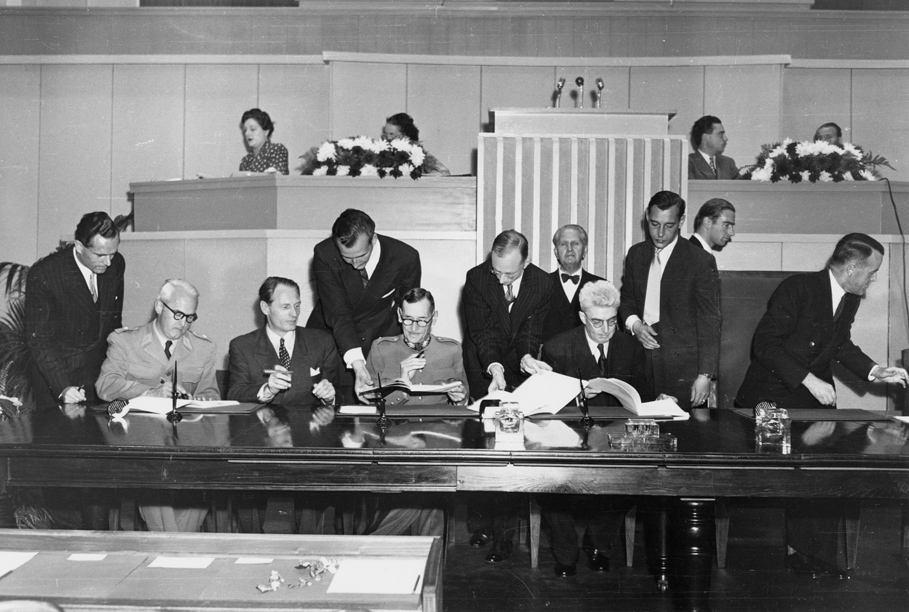
Geneva Conventions signing in 1949. © Wikimedia
This whole notion that war should be restrained, should be constrained, is completely tied to the humanitarian project. And humanitarian actors have been key figures in promoting developments within this legal framework. This framework is voluntary. It is based on states signing treaties: the 1951 Refugee Convention and its later amendments; conventions concerning the treatment of the wounded and the sick, beginning with the first Geneva Convention. All of these conventions together form a corpus of law framed around the idea that conflict should not be about inflicting the maximum possible suffering.
War, in this view, should serve strategic objectives — not genocidal ones. Humanitarian actors obviously have a strong interest in this framework because their action depends upon humanitarian law granting them access to those who suffer. But there is also a complexity here because these laws fundamentally operate as codes of behaviour between rational actors.
Civil wars
Civil wars have been notorious sites of abuse, systematic violence, and attacks on healthcare that target not only humanitarian workers but every form of healthcare provision.
One of the worst recent examples has, of course, been the Syrian Civil War, where the destruction of hospitals, the destruction of medical infrastructure, and the prevention of access became such severe problems that people sometimes refused to go to hospital because they believed hospitals were more dangerous places than home — even for giving birth.
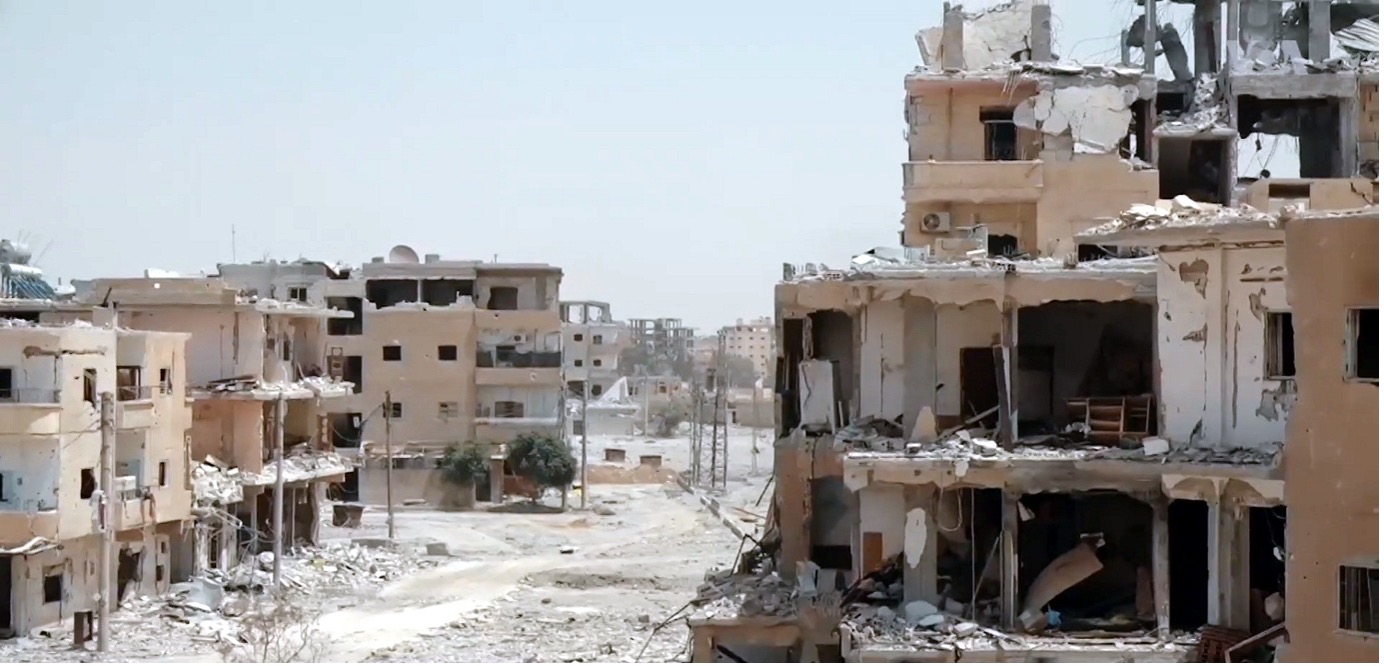
A destroyed part of Raqqa (Syria). © Wikimedia
So we arrive at a situation in which a legal framework is broadly understood and widely disseminated. The International Committee of the Red Cross, for example, gave soldiers little manuals explaining the Geneva Conventions. German soldiers going to war in 1870 carried them. During the First World War, soldiers again received small guides outlining what they could and could not do. Much military education developed in that direction. And more recently, the Red Cross movement has even attempted to educate insurgent and rebel groups. Interestingly, many insurgencies themselves have attempted to sign or recognise the Geneva Conventions.
The humanitarian legal framework is the framework within which humanitarian actors can operate. But it is fundamentally based on the idea that there exists a common understanding. To a very large extent, humanitarian law relies on good faith. And it becomes very clear in conflicts emerging especially after 2000 — after 9/11 and the so-called War on Terror — that the boundaries between civilian and military targets become increasingly blurred. The concept of proportionality — the idea that allows retaliation against, for example, a hospital from which a missile may have been launched — becomes deeply contested. And so we arrive at a situation today in which belief in humanitarian law has been considerably weakened. We are living through a difficult moment in the history of humanitarian law — in its practice, its authority, and even in the understanding of its most basic principles.
Bringing perpetrators to court
One of the paradoxes of humanitarian law — and this paradox is present almost from the very beginning — is that if you have a law, you also need a policeman or policewoman.
One of the first architects of international humanitarian law was Gustave Moynier, effectively the real founder of the International Committee of the Red Cross in Geneva. From the 1870s onwards, Moynier argued that a legal system requires some form of jurisdiction, some kind of court, some kind of legal framework within which perpetrators can be held accountable.
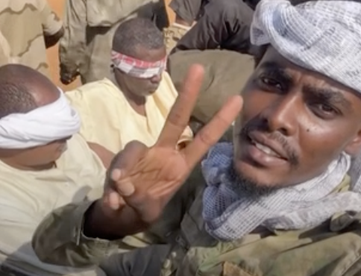
El-Fasher massacre perpetrator with victims, Sudan. © Wikimedia
Of course, there have been attempts to create international criminal courts, and today there is an International Criminal Court. But not every state is a signatory to it. Some of the world's leading powers are not signatories. And if you look at the number of cases actually prosecuted, it is rather disappointing compared with the number of perpetrators who remain free or continue to enjoy political power. Part of the problem, of course, is bringing people before a court. You need some degree of control over their bodies. You need to be able to arrest them.
And the second issue is evidence. When appearing in court, you need evidence of extremely high quality. Humanitarian actors are witnesses, and they can testify to what they personally observe. But what they see is often fragmentary. They can only observe the specific situation in front of them. They do not have a bird's-eye view. The testimony they provide is often not forensic enough to sustain a successful prosecution according to the highest legal standards.
So we have this tension between humanitarian actors who regularly and repeatedly denounce perpetrators, and courts that are eager — at least in principle — to prosecute leading perpetrators. But the gap lies in the availability of evidence and in the quality of that evidence.
Collecting evidence
We should consider the extent to which perpetrators are often keen to destroy evidence. This is something we see repeatedly.
The crimes committed in the former Yugoslavia during the 1990s, for example, included the destruction of bodies and corpses, the dispersal of remains, the destruction of records, and the manipulation or editing of records.
So humanitarian actors, simply by collecting evidence of what they do — or by keeping records of the people with whom they engaged and the situations they encountered — are in fact creating substantial archives. These archives may later help communities understand the circumstances in which they suffered, and may even have legal implications.
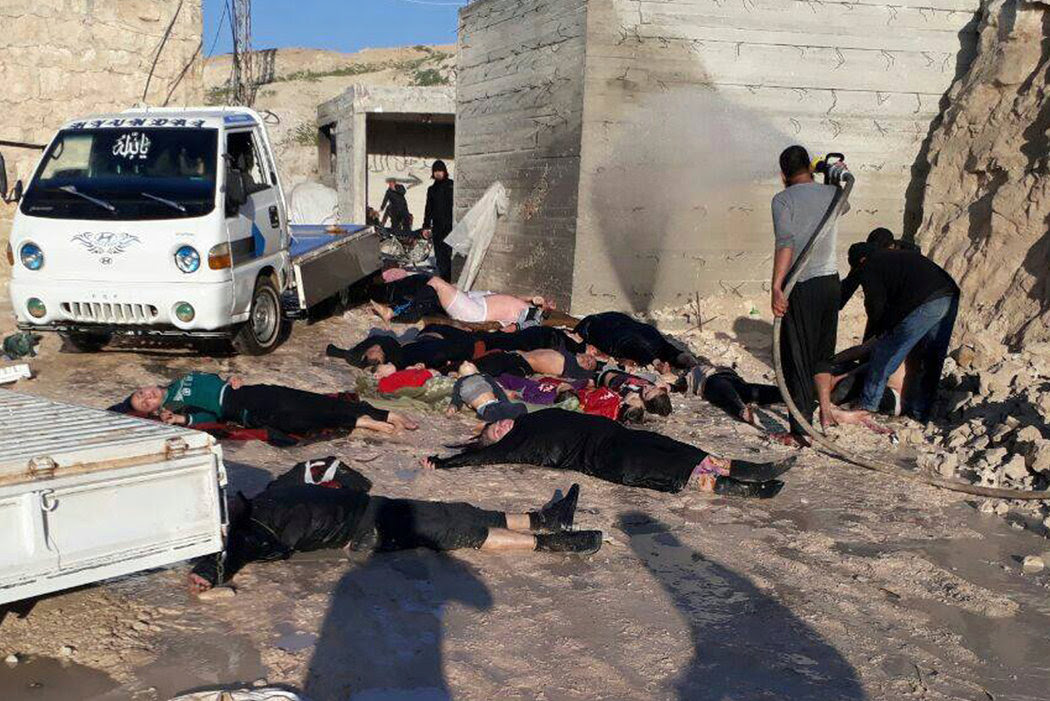
© Edlib Media Center
That makes these records sensitive, fragile, and highly vulnerable to erasure. This presents a major challenge for contemporary humanitarian actors because this kind of data inevitably acquires a security dimension. That can lead to self-censorship, incomplete collection, or restricted preservation. And in the digital world we now inhabit, it is extremely easy for records to be neglected, lost, or simply allowed to disappear.
A recent example would be when Médecins Sans Frontières denounced the use of chemical weapons during the Syrian Civil War. There was debate within the organisation about whether humanitarian workers had directly witnessed evidence of chemical warfare. What they had instead were numerous witnesses saying they had seen bombs fall and had seen people die in horrific circumstances. But is witness testimony collected outside a formal legal process sufficient evidence? Not necessarily. What matters, however, is that these records are preserved.
Because when historians later attempt to reconstruct events such as the Syrian Civil War, they need to understand the full range of witnesses and actors able to report on what occurred. Triangulated evidence — multiple overlapping testimonies and records — creates a much stronger historical record. Humanitarian archives, in short, are essential for the history of vulnerable communities: communities affected by war, epidemics, and disaster.
Humanitarian archive emergency
The preservation of these records is today at risk. It is at risk because of technological challenges associated with digital preservation on the one hand. It is at risk because of the desire for erasure often found in authoritarian regimes. But it is also at risk because of a political reframing of humanitarian aid as something partisan, or as something whose records some actors would rather not preserve.
Recently, with support from the The Leverhulme Trust and the Wellcome Trust, we launched a Humanitarian Archive Emergency initiative. This is a collaborative effort involving partners across the globe to draw attention to what we see as a major problem — not only for the writing of history, but also for humanitarian action itself.

© Shutterstock
The nature of this emergency is tied to several distinct factors. The first is that we live in a deeply interconnected world, but much of that interconnection now takes digital forms that are extremely difficult to preserve. In other words, archives no longer form naturally. Records do not simply deposit themselves over time. They have to be actively collected. WhatsApp messages disappear. Emails are difficult to archive. Much of the digital communication on which humanitarian work now depends is inherently fragile. Neglect therefore becomes one of the principal causes of historical loss.
A second dimension — and this is deeply political — is the wave of cuts affecting the humanitarian sector. The British government abolished the Department for International Development in 2020. Sweden significantly reduced funding through Sida. Germany and France also reduced humanitarian funding. And, most dramatically, USAID — by far the largest donor within the humanitarian system — underwent severe dismantling and funding cuts. These transformations affect not only humanitarian action itself, but also the preservation of the records through which future generations will understand that action.
The people's voices
Historically, humanitarian actors, like many other organisations, have tended to establish what we might call archives of power — archives that best represent decision-making processes at headquarters in Paris, London, Washington, or elsewhere — rather than the experiences of people on the ground. The local negotiations, the negotiations with village authorities to gain access to children, the voices of patients in medical contexts — these smaller actors are often much less well documented.
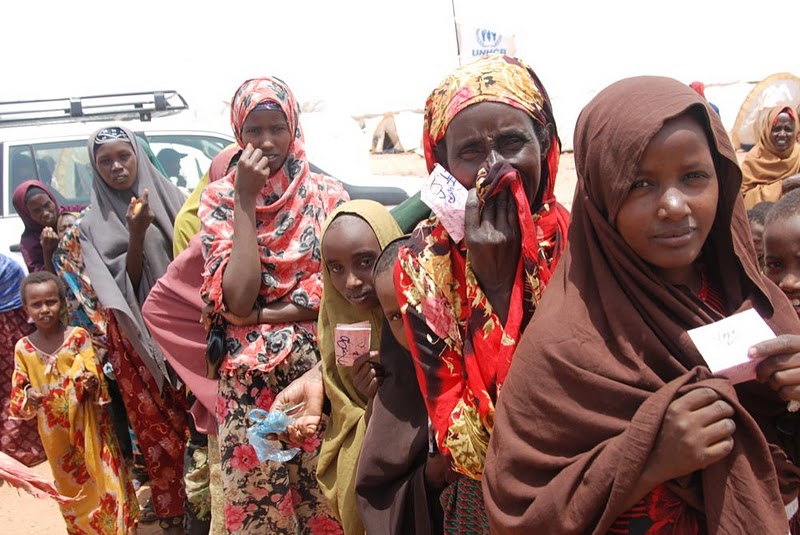
Somali refugees at the Dollo Ado transit camp, Ethiopia, 2011. © Wikimedia
And yet it is very difficult to write the history of humanitarian medicine if you forget that these are often the people who actually shape the circumstances and limitations of humanitarian intervention. The refugee health unit in Somalia is a prime example from our own research. We discovered that many international concepts and norms governing refugee aid were in fact first developed by the Somali Refugee Health Unit. This unit consisted of doctors working for the Somali government with Ogaden refugees, and they created guidelines that were then circulated among humanitarian actors operating in Somalia during the 1980s. Some of the international standards later adopted globally were actually first formulated locally, by actors who are often almost absent from conventional humanitarian archives.
A humanitarian duty
It is a common trope to say that history is written by the victors. And of course there are many different ways of expressing that idea — that the lions tell the story rather than the prey.
It is evident that when humanitarian actors engage with disasters, wars, conflicts, or epidemics, the vulnerability of the people with whom they work is far greater than normal. The likelihood that these people will disappear from the historical record is therefore extremely high.
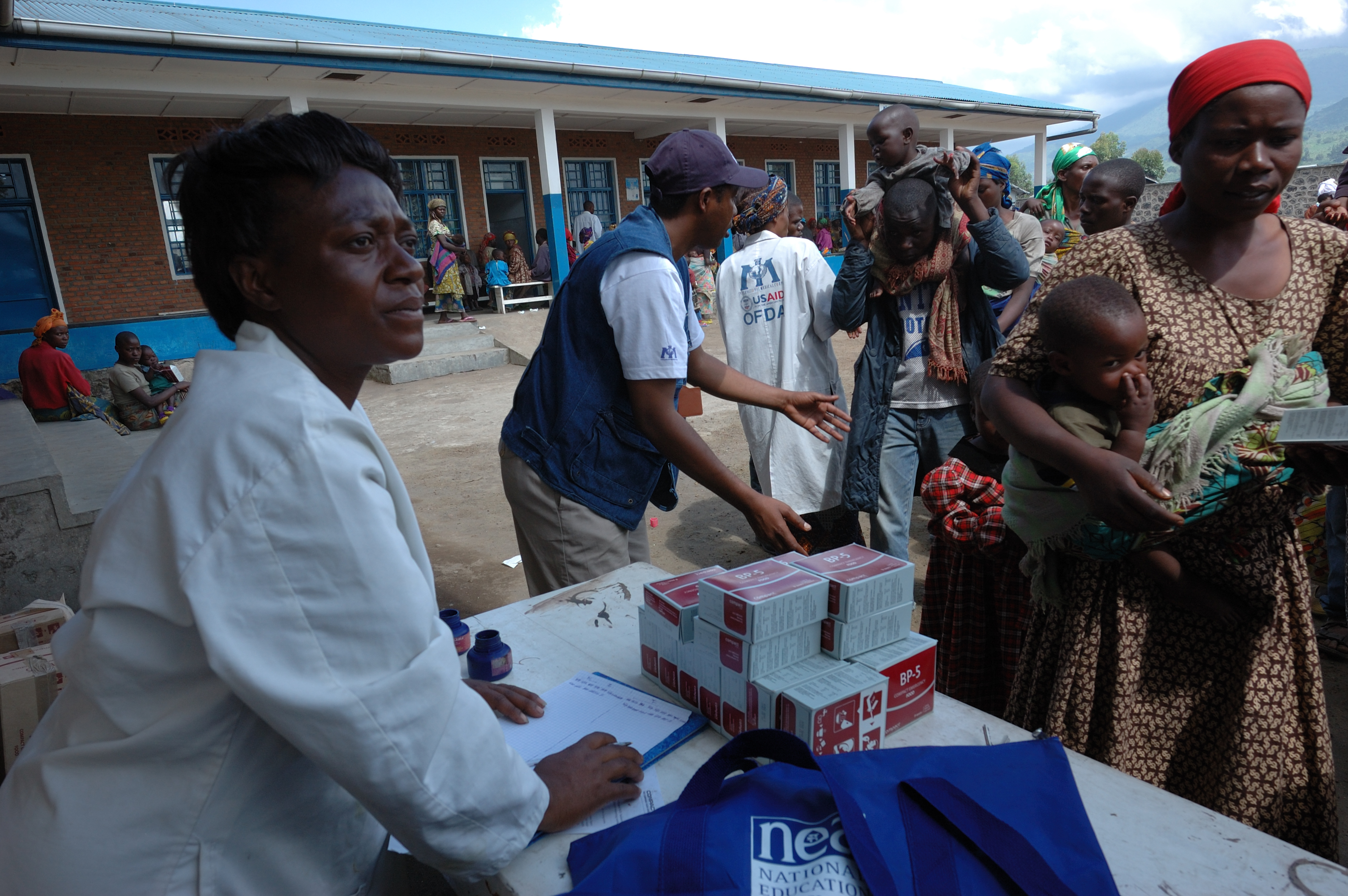
Distribution of BP-5 Emergency food packages in Goma, Democratic Republic of Congo, 2008. © Flickr via Wikimedia
Humanitarian actors have a duty to ensure that they do not disappear — that these people remain represented. In many cases, humanitarian actors are speaking on their behalf. When archives disappear, you are not simply erasing a situation from memory. You are also enabling, or facilitating, a culture of entitlement — a culture in which crimes go unrecorded, suffering is neglected, and moral relativism flourishes. And that ultimately favours the will of perpetrators. It produces a philosophy of life that stands as far away as possible from the idea of humanity that lies at the heart of humanitarianism. Without archives, none of these responsibilities can truly be fulfilled. You need this research infrastructure. Otherwise a culture of impunity develops — and history shows that cultures of impunity almost invariably lead to greater atrocities.
Editor’s note: This article has been faithfully transcribed from the original interview filmed with the author, and carefully edited and proofread. Edit date: 2026
Discover more about
Modern humanitarianism
Taithe, B (PI), Rinaldi, S, Stickland, C, Chatt, F & Adeosun, T, HAE: Humanitarian Archive Emergency.
Taithe, B, Weissman, F & Le Paih, M, (2022), Historicising Humanitarian Action: Synchronicity in Historical Research and Archiving Humanitarian Missions. Journal of Humanitarian Affairs, 4, 2, p. 49-56.
Continue exploring




Explore this knowledge network
Continue exploring...
0:00 / 0:00